Greetings, I've done this post several times in the past. Real life is going to cause some interference during the day. Having a one-year old is pretty cool, but it does interfere with writing about baseball for 14 hours straight.
12:08: Strike one to Ian Kinsler. I'm going to go out on a limb and declare the Tigers the winners in year one of the Kinsler-for-Fielder deal.
12:10: Torii Hunter looked bad on that strikeout. He's a free agent after this season, and while he had a poor season he was generally a very good player for the last ten years. From 2004 to 2013 he hit .284/.343/.471. And despite only being a 0.4 bWAR player in 2014, it pushed his career number up to 50.3. I wouldn't vote for him, but there are worse players in the Hall of Fame.
12:21: Justin Verlander wasn't very good this year either, but his peripherals did come around in the second half, as he cut out those walks that killed him early in the year. No idea how he'll pitch today, but my feeling is that he'll be a good pitcher again in the future.
12:24: Speaking of peripherals, Stephen Strasburg's were awesome this year. League-best 242 strikeouts, and a sterling 2.94 FIP. My only playoff prediction is that I think he's going to be a monster. He's at a career high for innings, but he cruised into the end of the regular season.
12:31: Alex Avila has exactly 11 homers and 47 RBIs in each of the past two seasons. In 2012 he drove in 48.
12:41: Time Warner Cable isn't making this any easier. Also, Justin Verlander is pitching a no-hitter. Am I doing this right?
12:44: Tigers shortstop was one of the worst positions in baseball this season. The player they settled on, Andrew Romine, plays average defense and hit .227/.279/.275, which is almost exactly his career line over parts of four season. For comparison's sake, their starting SS on opening day was Alex Gonzalez, who hit .167/.219/.233. I expect to see Eugenio Suarez at some point this weekend.
12:48: That always scares me. Sweet grab by Chen.
12:53: Dennis Eckersley is 60? Good grief.
12:57: I started following baseball in 1988, and Dennis Eckersley's transition to relief ace, redefining the closer role, was one of the biggest stories of that time. To someone who started watching baseball this season, that would be like someone telling me about 1962.
12:59: Schoop breaks up the no-hitter. For those of you following on GameCast or otherwise on the internet, it is pronounced like the mouthwash, not like that Salt N' Peppa tune.
1:04: Speaking of Eck, pretty prescient of him, noticing that Verlander was only throwing Markakis fastballs, an he finally turned on one. Even if it gets called back, that was a rocket.
1:12: Call stands. Alice has awoken. Time for a quick call to the bullpen for a pitching change, and then some play time. I will check in periodically (maybe). More to come tonight!
2:09: Quick check-in. There were some home runs while I was gone. Anyhow, an observation that is tangentially related to baseball. When the televisionis on, Alice (my daughter) really reacts to it. During that sweet 5-4-3 double play in the top of the fifth, the announcer got appropriately excited, and Alice started yelling along with it. It was awesome.
2:33: I like the move to bring in Sanchez. Given the Tigers bullpen problems, it's worth the risk. Now I'm on record, feel free to quote me when this blows up.
2:45: FoxSports just twittered a picture of its pregame desk crew. Frank Thomas and Gabe Kapler are sitting next to each other. Do not mess with that side of the table.
5:18: So some stuff happened in the last two and a half hours? I can't provide a ton of analysis because I wasn't watching closely, and what can be said about the first game other than "The Tigers bullpen stinks." Joba Chamberlain blowing the game brings me joy.
5:26: Can Jake Peavy take the duck boat he bought into the San Francisco Bay? Because that would be kind of cool. He's clear outpitched Strasburg today, against a very good Washington lineup. It's a little bit surprising, but Peavy is 12th among active pitchers in bWAR so maybe it shouldn't be.
5:49: All three Giants pitchers in the sixth inning are ex-Red Sox. Jake Peavy and Javier Lopez people know about. Hunter Strickland was an 18th-round pick in 2007 and was traded to Pittsburgh (with infielder Argenis Diaz) in exchange for Adam LaRoche. Nine days later, the Sox flipped LaRoche for Casey Kotchman.
6:00: I'm not in love with the playing of God Bless America during the seventh inning stretch, but I am in love with it when it is played by the Marine Corps Marching Band.
6:38: Two games at once is easy. Two games at once while giving the baby a bath and cleaning the basement might be beyond my can.
7:03: Sergio Romo seems like one of those players who, by the time he finally got credit for being good, stopped being good.
7:27: Former Supreme Court Justice Jon Jay strikes out against current Supreme Commander of Worlds Clayton Kershaw.
7:41: Adrian Gonzalez has a reputation as a cool cat, but he was obviously pretty fired up there. I don't think Wainwright hit Puig on purpose, but if he did he's a fool.
7:45: Carl Crawford really had a nice bouneback season this year. He's not the player he was signed to be in 2011, but he posted a 2.4 bWAR after totaling 2.3 from 2011 to 2013. His decline is still stark - a player with an outside shot at Hall of Fame credentials four years ago is well, well short of that. Nice to see him drive in the go-ahead run.
8:29. I missed two innings putting Alice to be. In that time, Clayton Kershaw faced six batters and struck out five of them. I'm starting to think he's good at baseball.
8:34: Hey remember three months ago when Matheny took Wainwright ahead of Kershaw to start the All-Star game?
8:45: The Cardinals' relievers would pitch better if they were given numbers that indicated they weren't going to be cut in spring training.
8:55: Of course the Ashburn Award winner homers.
8:56: Adrian Gonzalez is a good defensive first baseman. Also, he led the National League in RBI despite having his worst full offensive season.
9:01: Hanley Ramirez's helmet keeps falling off. Does he need a tighter hemlet? I think that would annoy me.
9:11: Puig really closed the gap there. Great angle to keep Holliday at second base.
9:11: Three straight hits off Kershaw? What the what is going on?
9:13: There's at least a 10% chance Kershaw loaded the bases on purpose to give himself a challenge.
9:14: Pete Kozma getting put on the Cardinals postseason roster was insane, so of course Matheny is going to turn up a Yost and Kozma will hit a grand slam.
9:18: The BABIP God's are apparently unhappy with Clayton Kershaw.
9:26: Raise your hand if you expected Kershaw to give up five runs in an inning.
9:34: Before that Peralta groundout the Cardinals were 6 for 6 on balls in play in the inning. A few of the balls off Kershaw, especially the Carpenter double and Molina hit, were well struck. But that's some busted luck right there.
9:46: Yeah, totally lost track that the Angels-Royals game was set for 9:37. I am rusty.
9:51: The Royals didn't get anyone on base in the first, so they were unable to have anyone thrown out on the bases. Fortunately the Angels stepped up there.
10:03: Adrian Gonzalez goes boom. 10-8. This playoffs has been crazy.
10:10: I don't get how Pat Neshek can pitch like that.
10:11: Both games are between innings. Why are both games in between innings. More baseball please.
10:14: The third most famous author of the Federalist Papers is 2 for 4.
10:16: Offense is up in the playoffs this year because of bunting? Thanks Harold Reynolds, for actively making me miss Tim McCarver.
10:19: Joba Chamberlain's ERA is 108.00 in the playoffs. Couldn't happen to a more deserving fellow.
10:22: Legitimately great bun there by Moustakas to beat the shift. I understand stud hitters not bunting on the overshift - you want David Ortiz swinging for the fences. But if a team is going to shift like that for someone who hit .212/.271/.361 then yeah, bunt yourself onto first.
10:25: Then having your leadoff hitter sacrifice bunt in the third inning. Sigh.
10:32: Yasiel Puig up with a runner on third and two outs, down by one in the bottom of the ninth. Against a guy who throws 100. I likey.
10:36: And Mighty Yasiel has struck out. The Wainwright-Kershaw duel ends 10-9. I think you won if you bet the over.
10:38: Meanwhile a few miles south in Anaheim... Nice to see Yordano Ventura bouncing back from his tough appearance in the wild card game. Doesn't appear to have any effect, though I wonder if he'll be on a shorter pitch count.
10:55: Salvador Perez leadoff single. Does Infante bunt to get the Moustakas and Escobar?
10:57: Nope, Yost resisted the urge. I guess that's improvement!
11:05: Ventura retired 11 in a row but has given up two straight singles. That's not necessarily concerning, but he left that pitch to Aybar up and down the middle. Worth keeping an eye on.
11:07: The double play is the pitcher's best friend.
11:34: Ventura walks Trout, and Albert Pujols is coming up. Pujols is 0 for 6 in the series. Good luck, kid.
11:36: Worse pitchers than Yordano Ventura have given up game-tying hits to Pujols. That said, Ventura seems to be overthrowing a bit. I don't know if I'd let him face Kendrick here. Very dangerous situation.
11:38: Kendrick grounds harmlessly to third. 1-1 through six.
11:40: There is a fly in my family room and it is huge and it is annoying me.
11:43: Baldwinsville's own Jason Grilli on for the seventh. He struggled in the first half with Pittsburgh but pitched better after the trade out west. He was certainly more effective than Ernesto Frieri in that sort-of challenge trade.
11:52: Ventura for the seventh. At only 85 pitches and Herrera on the shelf I can see it, but I guess I'm a little surprised. Finnegan should be ready behind him.
12:03: I've had to power cycle my modem five times since starting this, twelve hours ago. Thanks for the consistency, Time Warner.
12:08: Yost makes a good move, going to Wade Davis in the tie game. And then of course C.J. Cron rips a first-pitch curveball for a double down the left-field line.
12:13: Great time for a TOOTBLAN!
12:15: Seriously, I get wanting to get to third with less than two outs. But the top of the order was coming up. He's already on second.
12:16: And I'm excited for the morons who, if the Royals win, will credit "small ball." The Angels are the ones wasting outs. Pitching and defense isn't small ball.
12:20: I really want the Royals to not score right here just to see what Yost does in another tie game in the bottom of the ninth. Stick with Davis? Go to Holland? The Mystery Box?
12:29: I know Alex Gordon is a much tougher out than Salvador Perez, but that run is important, too. Much better chance the Royals put up a crooked number this inning, making a potential comback in the bottom of the inning a significantly tougher task.
12:31: Got out of it. Trout/Pujols to start the bottom of the ninth.
12:34: I'm not sure there's a right person to face Mike Trout in the tie game of the bottom of the ninth. But Wade Davis and Greg Hollard are available, with all due respect to Jason Frasor it shouldn't be him.
12:35: And Frasor pops Trout up. Shows you what I know.
12:38: Pujols pops up too. Ned Yost's moves don't have consequences.
12:39: Extra innings again! Who needs sleep?!
12:44: Huston Street on for a second inning of work, and he strikes out Omar Infante. Pretty amazing that Street had zero games this season where he recorded more than three outs. The rigidity of modern bullpen usage drives me bats.
12:53: Brandon Finnegan needs only one pitch to get his first out. Did you know he was in college earlier this year and selected in the 2014 draft? Did you? Huh? Huh? Did you? The blue cheese is baked right in, folks.
12:59: Going to the 11th. Excellent 3-6-3 by the Royals there. Very impressive play for Hosmer to field, throw, and get back to the bag in plenty of time to receive th e relay.
1:06: Two-run homer. Eric Hosmer. Incredible.
1:21: Greg Holland is good. I can't believe the "save your closer in case your worse relievers don't blow it" keeps working.
1:24: OH MY GOD STOP CALLING HIM BIG GAME JAMES.
1:25: Error extends the game for Mike Trout. Trout is probably good enough to hit a three-run homer with only one man on base, so the Royals should be careful.
1:25: But seriously stop with the Big Game James. He's pitched in seven playoff games and is 2-4 with a 5.26 ERA. He's an awful pitcher in big games. He's done his best work in April. We can call him Cold Game James or something. But he absolutely cannot take James Worthy's nickname.
1:27: Mike Trout strikes out to end it. He is 0 for 8 in the two games. Four games today. Three decided by one run, the other going into extra innings. It is very late here in the northeast portion of the midwest, so I shall depart. Thanks if you've been following along. Also, seek help.
Showing posts with label Los Angeles Angels. Show all posts
Showing posts with label Los Angeles Angels. Show all posts
Friday, October 03, 2014


Wednesday, August 31, 2011
Mike Trout Makes Me Look S-M-R-T
Ok, so usually when I post something about how someone should play more, or is better than you think, they immediately put up a stink bomb. The most obvious case this year was Madison Bumgarner having the worst starting pitching line of the year the day I posted that he was much better than his win-loss record. I'd been right a couple times, like when I talked about Desmond Jennings, but usually I make bold pronouncements and end up with egg on my face. So yesterday, when I posted about Mike Trout deserving more playing time, my assumption was that he'd start and go 0 for 5 with 3 strikeouts and ground into two double plays.
He didn't.
Trout did get the start last night, batting 7th against the Mariners. When Trout came up with the bases empty and one out in the second inning off of fellow rookie Anthony Vazquez, he hit a solo home run to deep LF to give the Angels a 1-0 lead. When he came up in the fourth inning with two on and one out, he hit a three run homer to give the Angels a 4-0 lead.
Two plate appearances, two home runs, driving in all four Angel runs.
Trout came up again in the 5th, with the game starting to get a bit out of hand. He walked with the bases loaded off of reliever Jeff Gray to "drive" in Torii Hunter to make it a 7-2 game, and scored on a Maicer Izturis double that made the score 10-2. He grounded out in the 7th and struck out in the ninth, giving him a game line of 2 for 4 with 2 homers, 3 runs, 5 RBI, 1 BB, 1 K, and a WPA of +.338.
Trout now has a season line of .246/.306/.523. He wakes up with a slugging percentage higher than Mark Teixeira or Carlos Quentin. It's a very small sample, but we don't really have any evidence that he isn't really really good. It isn't about the future. Trout gives them the best chance to sneak past the Rangers into the playoffs this year.
Keep your eye on that lineup card tonight.
He didn't.
Trout did get the start last night, batting 7th against the Mariners. When Trout came up with the bases empty and one out in the second inning off of fellow rookie Anthony Vazquez, he hit a solo home run to deep LF to give the Angels a 1-0 lead. When he came up in the fourth inning with two on and one out, he hit a three run homer to give the Angels a 4-0 lead.
Two plate appearances, two home runs, driving in all four Angel runs.
Trout came up again in the 5th, with the game starting to get a bit out of hand. He walked with the bases loaded off of reliever Jeff Gray to "drive" in Torii Hunter to make it a 7-2 game, and scored on a Maicer Izturis double that made the score 10-2. He grounded out in the 7th and struck out in the ninth, giving him a game line of 2 for 4 with 2 homers, 3 runs, 5 RBI, 1 BB, 1 K, and a WPA of +.338.
Trout now has a season line of .246/.306/.523. He wakes up with a slugging percentage higher than Mark Teixeira or Carlos Quentin. It's a very small sample, but we don't really have any evidence that he isn't really really good. It isn't about the future. Trout gives them the best chance to sneak past the Rangers into the playoffs this year.
Keep your eye on that lineup card tonight.
Tuesday, August 30, 2011
Mike Trout Sits Again. Angels Lose Again.
In four important division games since Friday, the Angels are 1-3. I thought I'd point out an interesting trend I noticed:
Record when Mike Trout starts: 1-0
Record when Mike Trout doesn't start: 0-3
Therefore, my incredibly oversimplified analysis of the situation is that the Angels are now incapable of winning games without Mike Trout.
Hey, we still use pitcher wins, right? Aren't Trout Wins just as legitimate? Aren't they?
No, of course not. Whether a batter is in a game that his team wins is even MORE prone to luck than the starting pitcher. The batter only gets abour 4 or 5 at bats in a game, plus however many defensive plays he may be involved in. A starting pitcher will usually be somewhere between 25-30 batters faced. A batter could go 4 for 4 with 4 home runs, and still lose 15-4 if everyone else on his team stinks. Pitcher wins are dumb. Batter wins are way, way dumber.
Still, the fact that not starting Mike Trout probably isn't the reason the Angels keep losing when they don't start him doesn't mean they shouldn't be starting him. (Did I put enough negatives in that sentence for you? Did it hurt your head? See, that's how I feel when I read about pitcher wins. Feel free to proceed).
There's a tool called "Win Probablity Added" going around the stat community. It does exactly what it says - measures each thing you do on the field and how much it changed your team's chances of winning.
I'm not a huge fan of the tool as a judge of "value" - it's kind of like RBI for us stat nerds, considering the situation and not the event. A player who hits a home run in the 8th inning of a tie game didn't do anything more valuable than the one who hits a home run to lead off the game, but it will obviously change the probability more. Because of this, it falsely inflates the "value" of closers, and devalues the value of starting pitchers who are on teams with a good offense - C.C. Sabathia giving up 1 run in 8 innings and winning 9-1 pitched just as well as Jered Weaver giving up 1 run in 8 innings and winning 2-1. FanGraphs directly states that it has no predictive value, and that there are better stats to use for raw player evaluations.
What WPA does well, on the other hand, is enhance the narrative of individual games. Joe Posnanski gives a nice post about that here, discussing the top 10 games by WPA.
(Aside. That #10 game, where Dwight Evans hit a home run to tie the game in the 8th inning, and then won it in the 10th, is my favorite non-playoff game in my Red Sox watching lifetime, and will be getting a follow-up post.)
Looking at the WPA for some of the great games in history is pretty fascinating. For example, I remember watching Game 4 of the 2001 World Series - the game where the Yankees beat the Diamondbacks with two home runs of Byung-hyn Kim, first by Tino Martinez in the 9th inning, then by Derek Jeter in the 10th. That's one of the most memorable game endings in recent history, but it's not what I remember it for. Nope, I remember that three times in that game, Tony Womack led off his inning with a hit. He hit singles in the first and third inning, and a double in the fifth. In EACH of those circumstances, Bob Brenly had Craig Counsell bunt. And, in EACH of those innings, the Diamondbacks failed to score any runs. I remember thinking how stupid it seemed that Brenly would waste all of those outs. Well, WPA confims it - those sacrifice bunts increased the Yankees chances of winning by 2%, each. WPA is not done retroactively - it doesn't recalculate based on what Martinez and Jeter did later on. It simply tells us what the consequences of a play are on the game and how they change the game at that time. What they tell us, in this situation, is that Brenly killed his team. Counsell had a .359 OBP in 2001 (from 2000-2005, it was .348, so that's not fluky). So, it stands to reason that, in three plate appearances, Counsell would get on base once. Or, in other words, NOT MAKE AN OUT once. Instead, because of Brenly's strategy, he made an out all three times. On purpose. We can't say for sure if the Diamondbacks lost because of that, but we know that their bad strategy didn't help them and that they lost by one run.
Wait, wait, I thought we were talking about Mike Trout? Where is this going, why are you writing about a playoff game from 10 years ago?!
Sorry, I got a little carried away there. I still can't think of Bob Brenly without thinking about that game.
Anyway. Mike Trout. WPA. Right.
On Friday, the Angels lost to the Rangers 11-7 and fell three games behind. They had been losing 11-0, but the back end of the Ranger bullpen apparently decided to give them a sporting chance. What did the non-Trout Angels' outfielders do?
LF Vernon Wells: 2-3, 2B, R; WPA +.002
CF Peter Borjous: 1-5, CS; WPA -.084
RF: Torii Hunter: 1-3; WPA -.061
TOTAL: .364/364/.455; WPA -.143
Recap: It's fair to use this as an example of why WPA isn't so hot sometimes. The Angels lost this game because Dan Haren stunk.
Trout Effect: Minimal. Though he got into the game late as a pinch hitter, going 1-2 with a single, the outfield wasn't the reason they lost. The end of the first inning, where Hunter struck out while Borjous was caught stealing while it was still a 0-0 game is why the WPA for the group is so bad.
On Saturday, Mike Trout started, and the Angels won 8-4. As a team, they hit 5 homers and moved back to two games behind.
LF Vernon Wells: 2-4, HR, 3B, BB, R, RBI; WPA +.127
CF Peter Borjous: 1-5, HR, SB, RBI, 2 R; WPA +.035
RF Mike Trout: 2-4, HR, R, RBI; WPA +.037
TOTAL: .385/.429/1.231; WPA +.199
Recap: Howie Kendrick and Bobby Wilson homered too. It's fair to say C.J. Wilson wasn't sharp in this one. Still, the Angel outfielders played a major role in the one.
Trout Effect: MAKES HIS TEAMMATES BETTER. KNOWS HOW TO WIN. Yeah, back to earth. He had a very good game, and was one of the reasons the Angels won.
On Sunday, Trout did not start, the Angels lost 9-5 and fell back to three games behind.
LF Vernon Wells: 1-4, RBI; WPA +.006
CF Peter Borjous: 0-4; WPA -.065
RF Torii Hunter: 0-3, BB; WPA -.060
TOTAL: .091/.167/.091; WPA -.119
Recap: The Angels were winning this one until Jered Weaver blew up in the 7th. The +.008 of Wells' two out RBI in the 3rd was largely negated by a pop out in the first with two outs and runners on first and second. Torii Hunter's strikeout in the third with a man on second and one out while leading 2-1 wasn't a highlight either.
Trout Effect: Notable. Despite the final, this was a close game for much of the way. A couple outs made by Hunter and Wells with runners in scoring position allowed Colby Lewis to stay in the game through six, which got the ball to the good part of the Ranger bullpen.
Last night, the Angels lost to the lowly Mariners, 5-3. With the Rangers off, the Angels fall to 3.5 games back. Jokes about the patheticness of the Mariner offense may now be passe. Allowing Dustin Ackley and Mike Carp to settle into the 3/4 spots in the lineup is making a big difference. Their .416 SLG as a team in August is 60 points higher than it was any other month, and their .329 OBP ranks 5th in the American League. Sleeper pick for 2012? Not quite ready to jump on that bandwagon, but with their pitching, getting an average offense can make them a serious contender.
LF Vernon Wells: 1-4, R; WPA -.074
CF Peter Borjous: 1-3; WPA -.146
RF Torii Hunter: 1-4, R; WPA -.052
TOTAL: .283/.283/.283; WPA -.272
Recap: Borjous's line drive double play when it was a 3-3 game in the 7th was a killer in the WPA department. The singles all came early in the game, limiting the WPA.
Trout Effect: Moderate. The guy DOES have a .426 SLG, doesn't he? This looks for the world like the kind of game where they needed an extra base hit to swing the balance.
So, over the last three days, Mike Trout has a WPA of +.037, while the rest of the Angel outfielders are at -.372. As we mentioned about, that has no predictive value, only narrative value. So, maybe we can't conclude that playing Mike Trout more would have helped them. What we do know is that, on the whole, the guys they did play didn't help them.
Record when Mike Trout starts: 1-0
Record when Mike Trout doesn't start: 0-3
Therefore, my incredibly oversimplified analysis of the situation is that the Angels are now incapable of winning games without Mike Trout.
Hey, we still use pitcher wins, right? Aren't Trout Wins just as legitimate? Aren't they?
No, of course not. Whether a batter is in a game that his team wins is even MORE prone to luck than the starting pitcher. The batter only gets abour 4 or 5 at bats in a game, plus however many defensive plays he may be involved in. A starting pitcher will usually be somewhere between 25-30 batters faced. A batter could go 4 for 4 with 4 home runs, and still lose 15-4 if everyone else on his team stinks. Pitcher wins are dumb. Batter wins are way, way dumber.
Still, the fact that not starting Mike Trout probably isn't the reason the Angels keep losing when they don't start him doesn't mean they shouldn't be starting him. (Did I put enough negatives in that sentence for you? Did it hurt your head? See, that's how I feel when I read about pitcher wins. Feel free to proceed).
There's a tool called "Win Probablity Added" going around the stat community. It does exactly what it says - measures each thing you do on the field and how much it changed your team's chances of winning.
I'm not a huge fan of the tool as a judge of "value" - it's kind of like RBI for us stat nerds, considering the situation and not the event. A player who hits a home run in the 8th inning of a tie game didn't do anything more valuable than the one who hits a home run to lead off the game, but it will obviously change the probability more. Because of this, it falsely inflates the "value" of closers, and devalues the value of starting pitchers who are on teams with a good offense - C.C. Sabathia giving up 1 run in 8 innings and winning 9-1 pitched just as well as Jered Weaver giving up 1 run in 8 innings and winning 2-1. FanGraphs directly states that it has no predictive value, and that there are better stats to use for raw player evaluations.
What WPA does well, on the other hand, is enhance the narrative of individual games. Joe Posnanski gives a nice post about that here, discussing the top 10 games by WPA.
(Aside. That #10 game, where Dwight Evans hit a home run to tie the game in the 8th inning, and then won it in the 10th, is my favorite non-playoff game in my Red Sox watching lifetime, and will be getting a follow-up post.)
Looking at the WPA for some of the great games in history is pretty fascinating. For example, I remember watching Game 4 of the 2001 World Series - the game where the Yankees beat the Diamondbacks with two home runs of Byung-hyn Kim, first by Tino Martinez in the 9th inning, then by Derek Jeter in the 10th. That's one of the most memorable game endings in recent history, but it's not what I remember it for. Nope, I remember that three times in that game, Tony Womack led off his inning with a hit. He hit singles in the first and third inning, and a double in the fifth. In EACH of those circumstances, Bob Brenly had Craig Counsell bunt. And, in EACH of those innings, the Diamondbacks failed to score any runs. I remember thinking how stupid it seemed that Brenly would waste all of those outs. Well, WPA confims it - those sacrifice bunts increased the Yankees chances of winning by 2%, each. WPA is not done retroactively - it doesn't recalculate based on what Martinez and Jeter did later on. It simply tells us what the consequences of a play are on the game and how they change the game at that time. What they tell us, in this situation, is that Brenly killed his team. Counsell had a .359 OBP in 2001 (from 2000-2005, it was .348, so that's not fluky). So, it stands to reason that, in three plate appearances, Counsell would get on base once. Or, in other words, NOT MAKE AN OUT once. Instead, because of Brenly's strategy, he made an out all three times. On purpose. We can't say for sure if the Diamondbacks lost because of that, but we know that their bad strategy didn't help them and that they lost by one run.
Wait, wait, I thought we were talking about Mike Trout? Where is this going, why are you writing about a playoff game from 10 years ago?!
Sorry, I got a little carried away there. I still can't think of Bob Brenly without thinking about that game.
Anyway. Mike Trout. WPA. Right.
On Friday, the Angels lost to the Rangers 11-7 and fell three games behind. They had been losing 11-0, but the back end of the Ranger bullpen apparently decided to give them a sporting chance. What did the non-Trout Angels' outfielders do?
LF Vernon Wells: 2-3, 2B, R; WPA +.002
CF Peter Borjous: 1-5, CS; WPA -.084
RF: Torii Hunter: 1-3; WPA -.061
TOTAL: .364/364/.455; WPA -.143
Recap: It's fair to use this as an example of why WPA isn't so hot sometimes. The Angels lost this game because Dan Haren stunk.
Trout Effect: Minimal. Though he got into the game late as a pinch hitter, going 1-2 with a single, the outfield wasn't the reason they lost. The end of the first inning, where Hunter struck out while Borjous was caught stealing while it was still a 0-0 game is why the WPA for the group is so bad.
On Saturday, Mike Trout started, and the Angels won 8-4. As a team, they hit 5 homers and moved back to two games behind.
LF Vernon Wells: 2-4, HR, 3B, BB, R, RBI; WPA +.127
CF Peter Borjous: 1-5, HR, SB, RBI, 2 R; WPA +.035
RF Mike Trout: 2-4, HR, R, RBI; WPA +.037
TOTAL: .385/.429/1.231; WPA +.199
Recap: Howie Kendrick and Bobby Wilson homered too. It's fair to say C.J. Wilson wasn't sharp in this one. Still, the Angel outfielders played a major role in the one.
Trout Effect: MAKES HIS TEAMMATES BETTER. KNOWS HOW TO WIN. Yeah, back to earth. He had a very good game, and was one of the reasons the Angels won.
On Sunday, Trout did not start, the Angels lost 9-5 and fell back to three games behind.
LF Vernon Wells: 1-4, RBI; WPA +.006
CF Peter Borjous: 0-4; WPA -.065
RF Torii Hunter: 0-3, BB; WPA -.060
TOTAL: .091/.167/.091; WPA -.119
Recap: The Angels were winning this one until Jered Weaver blew up in the 7th. The +.008 of Wells' two out RBI in the 3rd was largely negated by a pop out in the first with two outs and runners on first and second. Torii Hunter's strikeout in the third with a man on second and one out while leading 2-1 wasn't a highlight either.
Trout Effect: Notable. Despite the final, this was a close game for much of the way. A couple outs made by Hunter and Wells with runners in scoring position allowed Colby Lewis to stay in the game through six, which got the ball to the good part of the Ranger bullpen.
Last night, the Angels lost to the lowly Mariners, 5-3. With the Rangers off, the Angels fall to 3.5 games back. Jokes about the patheticness of the Mariner offense may now be passe. Allowing Dustin Ackley and Mike Carp to settle into the 3/4 spots in the lineup is making a big difference. Their .416 SLG as a team in August is 60 points higher than it was any other month, and their .329 OBP ranks 5th in the American League. Sleeper pick for 2012? Not quite ready to jump on that bandwagon, but with their pitching, getting an average offense can make them a serious contender.
LF Vernon Wells: 1-4, R; WPA -.074
CF Peter Borjous: 1-3; WPA -.146
RF Torii Hunter: 1-4, R; WPA -.052
TOTAL: .283/.283/.283; WPA -.272
Recap: Borjous's line drive double play when it was a 3-3 game in the 7th was a killer in the WPA department. The singles all came early in the game, limiting the WPA.
Trout Effect: Moderate. The guy DOES have a .426 SLG, doesn't he? This looks for the world like the kind of game where they needed an extra base hit to swing the balance.
So, over the last three days, Mike Trout has a WPA of +.037, while the rest of the Angel outfielders are at -.372. As we mentioned about, that has no predictive value, only narrative value. So, maybe we can't conclude that playing Mike Trout more would have helped them. What we do know is that, on the whole, the guys they did play didn't help them.
Monday, August 29, 2011
Potential Impact Callups
It's hard to believe we're already here, but in only three days, it will be September 1. Teams in contention will be racing to set up their playoff rosters, those out of contention will be checking out some of the players who could help them in the future. I just wanted to look at a few of the guys who could make an impact either in the pennant races or playoffs.
Mike Trout, Angels: I've discussed Trout a couple times, and I maintain my belief that he's the #1 "prospect" in baseball. It's possible that Trout will exhaust his rookie status in September, making him ineligible for the 2012 ROY award. If he doesn't, he is the serious favorite. That's not the Angels concern right now, though. Sitting only three games behind the Rangers, Trout may give them the best shot to close that gap.
Trout got the start in only one of the three games in the important series against the Rangers this past weekend, getting the right field nod in Saturday's game. Just by chance, it's the only game in the series the Angels won. Trout also got two at bats after coming in as a pinch hitter in Friday nights game. For the series, he went 3 for 6, with a home run and a strikeout. His impact down the stretch will depend entirely on how much Scioscia plays him.
Jesus Montero, Yankees: Let's all say this together. Jesus. Montero. Is. Not. A. Catcher.
We have that out of the way. It's ok, Yankee fans. Carlos Delgado wasn't a catcher either, no matter how much the early '90's Blue Jays wanted him to be. Delgado hit so much that nobody cared. I don't know if Montero will become the hitter Delgado was, but he'll hit enough that it won't make a difference.
The Yankees overall production at DH this year hasn't been as bad as you probably think. They've hit .247/.331/.432, good for 8th in the AL in OBP and 5th in SLG. However, that number is inflated some by the time spent DH-ing by guys who play other positions. In 21 games, Robinson Cano, Nick Swisher, Mark Teixeira and Alex Rodriguez have gone .256/.351/.512. The "regular" DH, Jorge Posada, has gone .232/.306/.390 at the position. Among the 14 regular DH's, that puts him tied for last in OBP, and 11th in SLG, a number that may be inflated by Yankee Stadium, since 7 of his 9 doubles, and 9 of his 12 home runs are there. Away from the Stadium's short porch, he's hit a paltry .187/.274/.302.
Meanwhile, much has been made of Montero's season. Is he a catcher, is he overrated because of the Yankees, is he better than Posada? Short answers - no, maybe, yes. Despite a drop in production from last year, Montero has hit .289/.348/.465 for Scranton. The lack of power from his first half has been forgotten - since the All-Star Break he's at .287/.353/.559. He's not the #3 prospect in baseball, where he was placed before the season, but he's ready for the majors. The Yankees' insistence on keeping him in the minors has cost them, but shouldn't for much longer. Expect to see him starting on Thursday at the latest.
Trevor Bauer, Diamondbacks: The #3 pick in the 2011 draft may well be the first to debut. Bauer signed early and has dominated since - in six starts and 24 innings across two levels, he has a 2.62 ERA, 30 strikeouts and only 9 walks. There has been some worry about his workload, but he may well get a chance to help the already-excellent Arizona bullpen. I doubt we'll see him start unless there is an obvious opening or the playoff race opens up.
One qualifier - I sincerely hope he doesn't pull a Jonathan Papelbon or Neftali Feliz and dominate so much out of the bullpen that he is made the "future closer." Bauer is worth more as a starter, both to his team and in consideration of his own checkbook.
Matt Moore, Rays: Are the Rays still in contention? Well, they have six games left with the Yankees, and they're 6.5 games behind. So, while it would take a pretty amazing comeback for them to get into the playoffs, it's not out of the realm of possibility. It's also very possible they'll end up with the 3rd best record in the American League and still miss the playoffs.
Moore was the darling of the future's game, and has been dominant since his promotion to Triple A Durham. In 46.2 innings, he has a 1.35 ERA, a 0.943 WHIP, 69 strikeouts, 15 walks and 3 home runs allowed, and he is a southpaw, which makes him a great matchup for the lefty-heavy opponents at the top of the division. If Trout loses rookie status, Moore becomes the front runner for the 2012 award. Unlike Bauer, I don't see Moore being used in the bullpen - he'll either get a couple starts, or be shut down. (Unless I'm wrong, of course. That's happened before.)
Mike Trout, Angels: I've discussed Trout a couple times, and I maintain my belief that he's the #1 "prospect" in baseball. It's possible that Trout will exhaust his rookie status in September, making him ineligible for the 2012 ROY award. If he doesn't, he is the serious favorite. That's not the Angels concern right now, though. Sitting only three games behind the Rangers, Trout may give them the best shot to close that gap.
Trout got the start in only one of the three games in the important series against the Rangers this past weekend, getting the right field nod in Saturday's game. Just by chance, it's the only game in the series the Angels won. Trout also got two at bats after coming in as a pinch hitter in Friday nights game. For the series, he went 3 for 6, with a home run and a strikeout. His impact down the stretch will depend entirely on how much Scioscia plays him.
Jesus Montero, Yankees: Let's all say this together. Jesus. Montero. Is. Not. A. Catcher.
We have that out of the way. It's ok, Yankee fans. Carlos Delgado wasn't a catcher either, no matter how much the early '90's Blue Jays wanted him to be. Delgado hit so much that nobody cared. I don't know if Montero will become the hitter Delgado was, but he'll hit enough that it won't make a difference.
The Yankees overall production at DH this year hasn't been as bad as you probably think. They've hit .247/.331/.432, good for 8th in the AL in OBP and 5th in SLG. However, that number is inflated some by the time spent DH-ing by guys who play other positions. In 21 games, Robinson Cano, Nick Swisher, Mark Teixeira and Alex Rodriguez have gone .256/.351/.512. The "regular" DH, Jorge Posada, has gone .232/.306/.390 at the position. Among the 14 regular DH's, that puts him tied for last in OBP, and 11th in SLG, a number that may be inflated by Yankee Stadium, since 7 of his 9 doubles, and 9 of his 12 home runs are there. Away from the Stadium's short porch, he's hit a paltry .187/.274/.302.
Meanwhile, much has been made of Montero's season. Is he a catcher, is he overrated because of the Yankees, is he better than Posada? Short answers - no, maybe, yes. Despite a drop in production from last year, Montero has hit .289/.348/.465 for Scranton. The lack of power from his first half has been forgotten - since the All-Star Break he's at .287/.353/.559. He's not the #3 prospect in baseball, where he was placed before the season, but he's ready for the majors. The Yankees' insistence on keeping him in the minors has cost them, but shouldn't for much longer. Expect to see him starting on Thursday at the latest.
Trevor Bauer, Diamondbacks: The #3 pick in the 2011 draft may well be the first to debut. Bauer signed early and has dominated since - in six starts and 24 innings across two levels, he has a 2.62 ERA, 30 strikeouts and only 9 walks. There has been some worry about his workload, but he may well get a chance to help the already-excellent Arizona bullpen. I doubt we'll see him start unless there is an obvious opening or the playoff race opens up.
One qualifier - I sincerely hope he doesn't pull a Jonathan Papelbon or Neftali Feliz and dominate so much out of the bullpen that he is made the "future closer." Bauer is worth more as a starter, both to his team and in consideration of his own checkbook.
Matt Moore, Rays: Are the Rays still in contention? Well, they have six games left with the Yankees, and they're 6.5 games behind. So, while it would take a pretty amazing comeback for them to get into the playoffs, it's not out of the realm of possibility. It's also very possible they'll end up with the 3rd best record in the American League and still miss the playoffs.
Moore was the darling of the future's game, and has been dominant since his promotion to Triple A Durham. In 46.2 innings, he has a 1.35 ERA, a 0.943 WHIP, 69 strikeouts, 15 walks and 3 home runs allowed, and he is a southpaw, which makes him a great matchup for the lefty-heavy opponents at the top of the division. If Trout loses rookie status, Moore becomes the front runner for the 2012 award. Unlike Bauer, I don't see Moore being used in the bullpen - he'll either get a couple starts, or be shut down. (Unless I'm wrong, of course. That's happened before.)
Thursday, August 11, 2011
Angels Send Mike Trout Back to AA, Might Not Know What They're Doing
When last we discussed Mike Trout here, the Angels had recalled him due to an injury to Peter Bourjos. I admit that I may have had delusions of grandeur, but there was always the chance that he wasn't quite ready. Indeed, his .163/.213/.279 line in 14 games showed that he wasn't quite ready for The Show. If the Angels were in the same position as the Mariners or Astros, playing for 2012 and beyond, it may have made sense to see what he could do in the last two months anyway, but the Angels are not in that position. Engaged in a closer-than-expected race with the Angels in the American League West, the Angels couldn't give Trout the playing time a super prospect needs. Here's where things get a little bit silly.
On August 1, the Angels demoted Trout all the way back down to AA - the level where he'd dominated to a .324/.415/.534 clip in 341 plate appearances. All six tools were on display, and he was the youngest player in his league. The only four players with higher OBPs were between 4 and 12 years older than Trout was. Given that level of production, wouldn't a promotion to AAA have been forthcoming, even if the major league promotion wasn't there?
Apparently Tony Reagins - who, let's let it be said, should have every decision he makes about an outfielder be thoroughly questioned - didn't think so, and sent Trout to continue his apprenticeship at a level where he seemingly has nothing left to learn. What has Trout done there? Why, the same thing he did every night - try to take over the wo.... errr, make AA pitchers feel bad about themselves. In 41 post-demotion plate appearances, he is batting .343/.439/.543, with 3 doubles, 2 triples, 4 steals and 6 walks.
Let me say this definitively. Mike Trout is ready for AAA.
The Angels keeping Trout in AA doesn't just stunt his progress, it stunts theirs as an organization. Most likely, Trout will be a major league callup in September. Wouldn't a month of facing AAA pitching - a major step up from AA for a variety of reasons, most notably the ability of pitchers to throw off-speed pitches for strikes - better prepare Trout to contribute when he does? If there IS a flaw in his game that AAA pitchers could expose, isn't working it out now, rather than next season, the best bet? If he dominates at AAA as well, doesn't he have to be considered a starter next year, to heck with how much money they owe Vernon Wells (who happens to have the worst OBP in the major leagues)?
The Angels, for all the dumb things they do like not playing Mike Napoli and trading Mike Napoli, have won a lot of games the last 10 years. The biggest reason they've won is from contributions from home grown talent. They will need to continue to do so in order to keep up with the Rangers, so it it is worth watching their handling of Mike Trout going forward.
On August 1, the Angels demoted Trout all the way back down to AA - the level where he'd dominated to a .324/.415/.534 clip in 341 plate appearances. All six tools were on display, and he was the youngest player in his league. The only four players with higher OBPs were between 4 and 12 years older than Trout was. Given that level of production, wouldn't a promotion to AAA have been forthcoming, even if the major league promotion wasn't there?
Apparently Tony Reagins - who, let's let it be said, should have every decision he makes about an outfielder be thoroughly questioned - didn't think so, and sent Trout to continue his apprenticeship at a level where he seemingly has nothing left to learn. What has Trout done there? Why, the same thing he did every night - try to take over the wo.... errr, make AA pitchers feel bad about themselves. In 41 post-demotion plate appearances, he is batting .343/.439/.543, with 3 doubles, 2 triples, 4 steals and 6 walks.
Let me say this definitively. Mike Trout is ready for AAA.
The Angels keeping Trout in AA doesn't just stunt his progress, it stunts theirs as an organization. Most likely, Trout will be a major league callup in September. Wouldn't a month of facing AAA pitching - a major step up from AA for a variety of reasons, most notably the ability of pitchers to throw off-speed pitches for strikes - better prepare Trout to contribute when he does? If there IS a flaw in his game that AAA pitchers could expose, isn't working it out now, rather than next season, the best bet? If he dominates at AAA as well, doesn't he have to be considered a starter next year, to heck with how much money they owe Vernon Wells (who happens to have the worst OBP in the major leagues)?
The Angels, for all the dumb things they do like not playing Mike Napoli and trading Mike Napoli, have won a lot of games the last 10 years. The biggest reason they've won is from contributions from home grown talent. They will need to continue to do so in order to keep up with the Rangers, so it it is worth watching their handling of Mike Trout going forward.
Friday, July 08, 2011
Mike Trout to Join Angels Tonight
The California Angels have announced that Mike Trout has been called up from AA Arkansas. This comes after starting CF Peter Borjous left last night's game with a right hamstring injury. Depending on who you ask, Trout is either the #1 prospect in baseball (Jonathan Mayo, me), or #2 behind Bryce Harper (Baseball America, just about everyone else).

The #25 pick in the 2009 draft out of Millville High School in Millville, NJ, Trout has hit .338/.423/.503 with 97 over 1148 plate appearances across four levels. This year, he has a .324/.415/.534 line in AA, with 12 doubles, 11 triples, 9 home runs and 28 steals - so I think it is fair to call his game "well rounded." Trout appears to be the rare type of dynamic player who combines patience, power AND speed. In addition to that, he plays fantastic defense, and has a great arm as well - he threw 90 as a high school pitcher.
So, what is the upside with Trout? Without exaggeration, it's elite, Hall of Fame level. Anything less than a multiple All-Star teams would be a disappointment. Trout is still only 19, yet there would be no one surprised if he is ready to contribute in a big way right now. With the Angels only a game behind the Rangers in the AL West, even a slight improvement in their outfield situation could make a major difference. Another story that bears watching - if Trout is ready, it may make Peter Bourjos expendable. Bourjos has matched quality defense with an offensive performance that's right about league average. Or, Trout could be moved to left field and start ahead of Vernon Wells. The thought of Bourjos and Trout together in the same outfield likely makes flyball pitchers Dan Haren and Jered Weaver positively giddy.
It's possible that we're getting ahead of ourselves here, of course. Trout doesn't turn 20 until August, and has never played in AAA. After Blake Beaven tonight, the Angels will see Michael Pineda tomorrow and Felix Hernandez tomorrow - not the type of pitchers one routinely faces in AA. (Wait, what was that? Michael Pineda WAS in AA most of last year? Anyway, my point still stands.) It's possible that Trout needs more seasoning and will return to the minors. That would likely be in AAA though, he has little left to prove in AA.
This isn't time to be pessimistic though, or even rational. Angels fans are encouraged to dream of Trout carrying them to the playoffs this year and being the superstar centerpiece to their franchise for the next two decades.

The #25 pick in the 2009 draft out of Millville High School in Millville, NJ, Trout has hit .338/.423/.503 with 97 over 1148 plate appearances across four levels. This year, he has a .324/.415/.534 line in AA, with 12 doubles, 11 triples, 9 home runs and 28 steals - so I think it is fair to call his game "well rounded." Trout appears to be the rare type of dynamic player who combines patience, power AND speed. In addition to that, he plays fantastic defense, and has a great arm as well - he threw 90 as a high school pitcher.
So, what is the upside with Trout? Without exaggeration, it's elite, Hall of Fame level. Anything less than a multiple All-Star teams would be a disappointment. Trout is still only 19, yet there would be no one surprised if he is ready to contribute in a big way right now. With the Angels only a game behind the Rangers in the AL West, even a slight improvement in their outfield situation could make a major difference. Another story that bears watching - if Trout is ready, it may make Peter Bourjos expendable. Bourjos has matched quality defense with an offensive performance that's right about league average. Or, Trout could be moved to left field and start ahead of Vernon Wells. The thought of Bourjos and Trout together in the same outfield likely makes flyball pitchers Dan Haren and Jered Weaver positively giddy.
It's possible that we're getting ahead of ourselves here, of course. Trout doesn't turn 20 until August, and has never played in AAA. After Blake Beaven tonight, the Angels will see Michael Pineda tomorrow and Felix Hernandez tomorrow - not the type of pitchers one routinely faces in AA. (Wait, what was that? Michael Pineda WAS in AA most of last year? Anyway, my point still stands.) It's possible that Trout needs more seasoning and will return to the minors. That would likely be in AAA though, he has little left to prove in AA.
This isn't time to be pessimistic though, or even rational. Angels fans are encouraged to dream of Trout carrying them to the playoffs this year and being the superstar centerpiece to their franchise for the next two decades.
Thursday, June 16, 2011
The Rise and Fall of Scott Kazmir
As you have probably heard, the Angels granted Scott Kazmir waivers today for the purpose of giving him his unconditional release. This cuts ties with a 27 year old who already has 66 career wins and 995 career strikeouts. After a dreadful first start of the season, the Angels had placed Kazmir on the DL with a severe case of "he's 27 and throws his fastball 7 mph less than he did when he was 23 and nobody can figure out why." After five "rehab" starts at AAA Salt Lake, GM Tony Reagins decided there was no place on the major league staff for Kazmir - an easy decision when you look at the fact that, in those five starts, Kazmir gave up 29 runs in 15.1 IP, walking 20 and striking out 14. He also had 5 WP and hit 6 batters. Never a control pitcher, Kazmir was all over the place, which was compounded by the fact his fastball, once one of the best in the league, is no longer even league average.
The story of Kazmir is a strange, often-repeated one. The Mets made him the #15 pick in the 2002 draft out of high school, and he signed quickly enough to make five excellent starts at Low-A Brooklyn, giving up only 1 ER in 18 innings while striking out 34. This debut performance was enough for Baseball America to make Kazmir the 11th best prospect in their 2003 pre-season rankings. In 2003, over two levels as a 19 year old, Kazmir continued to dominate, with a 2.65 ERA and 145 strikeouts in 109.1 innings. The 45 walks he had were enough to drop Kazmir to 12th in the Baseball America rankings. Still, being the #3 pitching prospect in baseball in nothing to sneeze at.
In 2004, Kazmir was excellent again. In 76 IP between high A and AA, he had a 2.84 ERA, 80 K, 31 BB and allowed only 3 HR. However, Mets' major league pitching coach Rick Peterson didn't like Kazmir's delivery - he thought it would be unsustainable over a long period of time, leading to injury and control trouble. A pitcher who Peterson DID like was Tampa Bay Ray starter Victor Zambrano. The 28 year old Zambrano had pitched for four years in Tampa, and was known mostly for his erratic (which might be too kind) control. In 481.2 IP with the Rays, he'd walked 288 batters. In 2003, he's led the AL with 106 walks (against only 132 strikeouts - this wasn't Nolan Ryan), and, at midseason 2004 already had 92 walks. Peterson liked Zambrano's stuff and general delivery and thought the control was the result of a correctable mechanical flaw.
So, what happened? The Mets traded the #12 prospect in baseball for the 28-year-old American League leader in walks at the trading deadline.
It seemed as dumb at the time as it does now. It would be like waking up tomorrow morning and finding out that the Braves had traded Julio Teheran to the Astros for JA Happ, and 28 other teams find out that not only was Teheran available, but all it would have taken to get him was a mediocre starter with serious control issues. This wasn't a contending team trading an unproven prospect for a proven veteran, like losing John Smoltz for Doyle Alexander. It was the Mets giving up on their top prospect because of one person's opinion, and getting nothing close to value in return. People jokingly asked whether Mets GM thought he was getting Cubs pitcher Carlos Zambrano and accidentally traded for the wrong Zambrano.
I should state that I've always thought Rick Peterson got too much of the blame for this turn of events. He's the pitching coach, not the general manager. The idea that Kazmir's delivery wasn't sustainable clearly has some merit in hindsight, and I'm going to bet that every pitching coach in the league has their eyes on a guy on another team who he things he can "fix." That's why it isn't the job of a pitching coach to make trades. The GM is in place to assess value, see what the best package he can get for a player, and Jim Duquette very obviously did not do that. That's why, personally, I view this as the worst trade in baseball history. If you analyze the long-term effect of a deal, clearly the Atlanta Braves getting John Smoltz or the Houston Astros getting Jeff Bagwell, or the Cardinals getting Lou Brock were enormous, but all of those were defensible. Trading your best prospect for one of the worst starters in the league?
Anyway, Victor Zambrano got hurt after three starts for the Mets. I suppose that Peterson was able to get him to lower his walk totals, as he walked 4.2 per 9 IP for the Mets, after walking 5.4 per 9 in his Rays career, but it had little benefit. Zambrano got hurt again in 2006, then bounced to the Blue Jays and Orioles in 2007 before falling out of the league.

Meanwhile, by 2007 Kazmir was turning into the best young pitchers in baseball. Called up only a month after the deal with the Mets, Kazmir, still only 20 struggled some at first. In 2005, he led the AL with 100 walks, but struck out significantly more batters than Zambrano, keeping his ERA down to 3.77, earning him 9th place in the AL Rookie of the Year voting. It was in 2006 and 2007 that Kazmir turned into the ace of the young (then Devil) Rays. In 351.1 innings pitched those two years, he struck out 402 and walked only 141. In 2007 as a 23 year old, he led the American League with 239 strikeouts. Kazmir for Zambrano was now a punchline.
In 2008, things started to go wrong for Kazmir. He strained his elbow in spring training, and while the issue was not reported to be serious, the Rays were still cautious, and Kazmir did not debut until May 4. Things went well enough from there, and Kazmir was named to his second straight all-star game, sporting a 3.05 ERA and a K/BB ratio of close to 3.0. In the second half, Kazmir appeared to be running out of gas - every indicator of effectiveness had dropped. He was striking out fewer batters, walking more, and giving up more home runs. His batting average against fell, a function of the Rays significantly improved defense behind him, but scouts were worried that his fastball was losing its bite.
In 2009, his velocity continued to drop, and Kazmir was now making serious money, having been signed before 2008 to a 4 year, $38.5M contract, was considered trade bait. Matt Garza, James Shields and David Price had already passed Kazmir, and the farm system was loaded with arms. At the trading deadline, Kazmir had a 5.92 ERA and was striking out barely 7 per 9 IP. Attributing the issues not to a termporary blip but to a loss in stuff, the Rays traded the 25-year-old Kazmir five years after acquiring him. He was sent to the Los Angeles Angels for utilityman Sean Rodriguez, minor league pitcher Alex Torres, and minor league first baseman Matthew Sweeney.
Kazmir improved upon being acquired by the Angels, but this was from a drop in his walk and home run rates rather than his stuff returning to its old level. In six starts, Kazmir had a 1.73 ERA in his first six starts, earning him a spot in their playoff rotation. This turned out to be a mistake, as in three playoff appearances he had a 7.93 ERA.
In 2010, Kazmir posted career worsts in nearly every category, and for the first time in his career, his fastball did not average 90 mph. By the end of the year, he had a 5.94 ERA, and in 150 innings pitched he struck out only 93, walked 79 and allowed 25 home runs - the highest walk and home run rates of any pitcher with 150 innings in the American League. Still hoping they could get something out Kazmir, and with him under contract for the season, the Angels broke camp in 2011 with him in the starting rotation. In his first start, he faced 14 batters - walking two, hitting two, giving up 5 hits including a home run, and allowing 5. He retired only 4 batters, none by strikeout. His fastball averaged 86 miles per hour.
It was at that point where the Angels decided to put Kazmir on the DL, because pitchers aren't supposed to throw 7mph slower at 27 than they did at 22 unless there is something physically wrong. Nothing specific was found, though, and with Kazmir getting lit up in 5 AAA starts, the Angels moved on.
At this point, I'm not sure where Kazmir can go. No team will put him in the majors. I almost think he'd be best off taking the rest of the year off, not pitching again until next spring, just throwing and playing long toss to build his arm strength back up. Still, we're not even sure that the issue is "arm strength." He may have just peaked athletically at a young age, and not have anything left in his 27 year old arm. If this is it though, Rays fans will always be able to remember him as one of the faces of the franchise in the mid-'00s when they actually began to improve.
Meanwhile, Rob Neyer recounts what Mets fans can remember (from his old ESPN blog):
In 2007 the Mets finished one game behind the first-place Phillies. In 2008 they finished three games behind the first-place Phillies. In 2006, their fourth starter in October was Steve Trachsel, who started twice and gave up seven runs in four-plus innings. It's not hard to imagine the Mets generating a great deal more income with Kazmir, because it's not hard to imagine them winning significantly more postseason games in those three years than they actually won.
And they didn't even get the right Zambrano.
The story of Kazmir is a strange, often-repeated one. The Mets made him the #15 pick in the 2002 draft out of high school, and he signed quickly enough to make five excellent starts at Low-A Brooklyn, giving up only 1 ER in 18 innings while striking out 34. This debut performance was enough for Baseball America to make Kazmir the 11th best prospect in their 2003 pre-season rankings. In 2003, over two levels as a 19 year old, Kazmir continued to dominate, with a 2.65 ERA and 145 strikeouts in 109.1 innings. The 45 walks he had were enough to drop Kazmir to 12th in the Baseball America rankings. Still, being the #3 pitching prospect in baseball in nothing to sneeze at.
In 2004, Kazmir was excellent again. In 76 IP between high A and AA, he had a 2.84 ERA, 80 K, 31 BB and allowed only 3 HR. However, Mets' major league pitching coach Rick Peterson didn't like Kazmir's delivery - he thought it would be unsustainable over a long period of time, leading to injury and control trouble. A pitcher who Peterson DID like was Tampa Bay Ray starter Victor Zambrano. The 28 year old Zambrano had pitched for four years in Tampa, and was known mostly for his erratic (which might be too kind) control. In 481.2 IP with the Rays, he'd walked 288 batters. In 2003, he's led the AL with 106 walks (against only 132 strikeouts - this wasn't Nolan Ryan), and, at midseason 2004 already had 92 walks. Peterson liked Zambrano's stuff and general delivery and thought the control was the result of a correctable mechanical flaw.
So, what happened? The Mets traded the #12 prospect in baseball for the 28-year-old American League leader in walks at the trading deadline.
It seemed as dumb at the time as it does now. It would be like waking up tomorrow morning and finding out that the Braves had traded Julio Teheran to the Astros for JA Happ, and 28 other teams find out that not only was Teheran available, but all it would have taken to get him was a mediocre starter with serious control issues. This wasn't a contending team trading an unproven prospect for a proven veteran, like losing John Smoltz for Doyle Alexander. It was the Mets giving up on their top prospect because of one person's opinion, and getting nothing close to value in return. People jokingly asked whether Mets GM thought he was getting Cubs pitcher Carlos Zambrano and accidentally traded for the wrong Zambrano.
I should state that I've always thought Rick Peterson got too much of the blame for this turn of events. He's the pitching coach, not the general manager. The idea that Kazmir's delivery wasn't sustainable clearly has some merit in hindsight, and I'm going to bet that every pitching coach in the league has their eyes on a guy on another team who he things he can "fix." That's why it isn't the job of a pitching coach to make trades. The GM is in place to assess value, see what the best package he can get for a player, and Jim Duquette very obviously did not do that. That's why, personally, I view this as the worst trade in baseball history. If you analyze the long-term effect of a deal, clearly the Atlanta Braves getting John Smoltz or the Houston Astros getting Jeff Bagwell, or the Cardinals getting Lou Brock were enormous, but all of those were defensible. Trading your best prospect for one of the worst starters in the league?
Anyway, Victor Zambrano got hurt after three starts for the Mets. I suppose that Peterson was able to get him to lower his walk totals, as he walked 4.2 per 9 IP for the Mets, after walking 5.4 per 9 in his Rays career, but it had little benefit. Zambrano got hurt again in 2006, then bounced to the Blue Jays and Orioles in 2007 before falling out of the league.

Meanwhile, by 2007 Kazmir was turning into the best young pitchers in baseball. Called up only a month after the deal with the Mets, Kazmir, still only 20 struggled some at first. In 2005, he led the AL with 100 walks, but struck out significantly more batters than Zambrano, keeping his ERA down to 3.77, earning him 9th place in the AL Rookie of the Year voting. It was in 2006 and 2007 that Kazmir turned into the ace of the young (then Devil) Rays. In 351.1 innings pitched those two years, he struck out 402 and walked only 141. In 2007 as a 23 year old, he led the American League with 239 strikeouts. Kazmir for Zambrano was now a punchline.
In 2008, things started to go wrong for Kazmir. He strained his elbow in spring training, and while the issue was not reported to be serious, the Rays were still cautious, and Kazmir did not debut until May 4. Things went well enough from there, and Kazmir was named to his second straight all-star game, sporting a 3.05 ERA and a K/BB ratio of close to 3.0. In the second half, Kazmir appeared to be running out of gas - every indicator of effectiveness had dropped. He was striking out fewer batters, walking more, and giving up more home runs. His batting average against fell, a function of the Rays significantly improved defense behind him, but scouts were worried that his fastball was losing its bite.
In 2009, his velocity continued to drop, and Kazmir was now making serious money, having been signed before 2008 to a 4 year, $38.5M contract, was considered trade bait. Matt Garza, James Shields and David Price had already passed Kazmir, and the farm system was loaded with arms. At the trading deadline, Kazmir had a 5.92 ERA and was striking out barely 7 per 9 IP. Attributing the issues not to a termporary blip but to a loss in stuff, the Rays traded the 25-year-old Kazmir five years after acquiring him. He was sent to the Los Angeles Angels for utilityman Sean Rodriguez, minor league pitcher Alex Torres, and minor league first baseman Matthew Sweeney.
Kazmir improved upon being acquired by the Angels, but this was from a drop in his walk and home run rates rather than his stuff returning to its old level. In six starts, Kazmir had a 1.73 ERA in his first six starts, earning him a spot in their playoff rotation. This turned out to be a mistake, as in three playoff appearances he had a 7.93 ERA.
In 2010, Kazmir posted career worsts in nearly every category, and for the first time in his career, his fastball did not average 90 mph. By the end of the year, he had a 5.94 ERA, and in 150 innings pitched he struck out only 93, walked 79 and allowed 25 home runs - the highest walk and home run rates of any pitcher with 150 innings in the American League. Still hoping they could get something out Kazmir, and with him under contract for the season, the Angels broke camp in 2011 with him in the starting rotation. In his first start, he faced 14 batters - walking two, hitting two, giving up 5 hits including a home run, and allowing 5. He retired only 4 batters, none by strikeout. His fastball averaged 86 miles per hour.
It was at that point where the Angels decided to put Kazmir on the DL, because pitchers aren't supposed to throw 7mph slower at 27 than they did at 22 unless there is something physically wrong. Nothing specific was found, though, and with Kazmir getting lit up in 5 AAA starts, the Angels moved on.
At this point, I'm not sure where Kazmir can go. No team will put him in the majors. I almost think he'd be best off taking the rest of the year off, not pitching again until next spring, just throwing and playing long toss to build his arm strength back up. Still, we're not even sure that the issue is "arm strength." He may have just peaked athletically at a young age, and not have anything left in his 27 year old arm. If this is it though, Rays fans will always be able to remember him as one of the faces of the franchise in the mid-'00s when they actually began to improve.
Meanwhile, Rob Neyer recounts what Mets fans can remember (from his old ESPN blog):
In 2007 the Mets finished one game behind the first-place Phillies. In 2008 they finished three games behind the first-place Phillies. In 2006, their fourth starter in October was Steve Trachsel, who started twice and gave up seven runs in four-plus innings. It's not hard to imagine the Mets generating a great deal more income with Kazmir, because it's not hard to imagine them winning significantly more postseason games in those three years than they actually won.
And they didn't even get the right Zambrano.
Thursday, May 05, 2011
Running Commentary - Cinco de Mayo Live Blog
1:30: It's time for some Thursday afternoon baseball! The Angels and Red Sox played until about 2:30 in the morning, so we're back after about 11 hours of rest. We found out that the Red Sox have placed Dan Wheeler and Bobby Jenks on the disabled list with various maladies. Of course, it's not at all suspicious that the two pitchers who have been the worst performers on the team so fart this year are placed on the DL on a day where the Red Sox need bullpen reinforcements.
1:35: Looks like Dustin Pedroia is getting his first off day of the year. Pedroia has been slumping a bit recently - since April 17th he is 11 for 66 without an extra base hit, capped by a round 0 for 6 last night. This adds to why I believe that, despite rumors, Marco Scutaro will not be traded. The Red Sox love the flexibility of being able to give any of their infielders a day off, and, because of the flexibility of Lowrie and Youkilis, still field a very good lineup. Throw in Lowrie's injury history, and keeping Scutaro on the payroll seems very sensible.
1:40: Nice single by Howie Kendrick up the middle on a pretty good curveball low and away. After years of hearing about how Kendrick was a "future batting champion," he's off to a very good .296/.371/.520 start. The increase in his walk rate from barely over 3% for his career to 9% this year is playing a big part.
1:48: The Red Sox do a lot of things right, especially in regards to their statistical analysis. However, over they years, they seem to have insisted on a "fast guy bats leadoff" strategy. Ellsbury, Lugo, Crisp, even going back to Johnny Damon. JD Drew has the skills that any stathead would want in a leadoff man. He works deep counts, gets on base, and presents enough extra base power to be dangerous, but doesn't hit so many homers that you would feel that they're "wasted" with nobody on base. At age 27, Ellsbury has a .343 career OBP. This is the player he is - he's a useful player to have on your team, but it's not a good enough number for your leadoff hitter, and Ellsbury is to the point where it's time to stop talking about potential.
1:59: Mark Trumbo leads AL rookies with 5 homers, but that ratio of 2 walks to 25 HRs is going to make it tough for him to see good pitches. Trumbo went .301/.368/.577 at AAA Salt Lake last year, with 58 walks, so he does seem to have some selectivity. No reason to count him out because of a low early season OBP, but he needs to make an adjustment. He also has a really awesome birthday going for him.
2:10: The Sox 2005 draft produced a fascinating class. Originally, Craig Hansen was the hot prospect, and flamed out. Clay Buchholz pitched the no-hitter and Jacoby Ellsbury was the spark plug in late 2007. In 2008, Buchholz and Ellsbury struggled, and Lowrie came on strong in the second half. In '09, Ellsbury was very good, Lowrie got hurt, and Buchholz was inconsistent. In '10, Ellsbury got hurt early, Buchholz was excellent, and Lowrie had a very good last two months. So far in 2011, Lowrie's been great, while Buchholz and Ellsbury have battled inconsistency. My rambling, incoherent point? The've gotten good play out of all three, but never at the same time.
2:22: Should a guy with a career line of .295/.400/.486 over 16 years with close to 400 career SB get some Hall of Fame consideration? Sounds like it, but I'm not ready to make that case for Bobby Abreu, when we can't even get Tim Raines into the Hall.
2:40: Mark Trumbo with the walk, which is good. Then he got caught stealing, which is not good. When you're having trouble getting on base, getting thrown out when you DO get on base is a poor strategy.
2:46: Don't let the stutter he's developed fool you - Peter Gammons is as awesome as ever. How many other guys would give in game commentary featuring a statistical comparison of Bobby Abreu and Johnny Damon, and then later a discussion of the future of the Angels outfield situation when Mike Trout arrives. Don't get me wrong, Jerry Remy is fantastic, and Dennis Eckersley is fun, but nobody gives the type of analysis that Gammons does. We Red Sox fans are spoiled.
2:48: Great example there of Ellsbury not being a good defensive CF. Mike Cameron gets to that ball, and the Red Sox are out of the inning. Instead, Ellsbury started back on a 140 foot pop up. His speed makes up for some of his terrible reads, but way too many of those flares into short center field turn into hits against the Red Sox.
2:51: Two singles later, and Ellsbury not getting to that ball really stand out. The commentary will be about Lackey, and he hasn't been sharp, but anyone who pitches to contact needs help behind him.
2:54: Atchison has started to warm up in the bullpen, but Francona may just need to leave Lackey in to take his lumps. Sometimes it's not your day, and there just aren't enough arms in the bullpen.
3:08: A two run homer from Trumbo runs Lackey from the game. After three straight very good starts, Lackey was not at all sharp today. The bullpen will need to get 15 outs. Not what the Sox were looking for after the 13 inning game last night.
3:15: This is turning into a little league game. The Red Sox should be a little bit embarrassed. How in the world is that a hit for Aybar? I can see crediting him with the RBI, but he hit a routine grounder to Gonzalez.
3:17: Rip to rightfield by Kendrick. Atchison may have to go the rest of this one, even if the Angels score another 15 runs.
3:23: Things go from bad to worse. Ortiz hits a fly ball off the monster... and Abreu throws him out at second base.
3:26: Let's check out the games around the league, shall we? David Price has a 4 hit, 10 strikeout game through 8 innings against Toronto, Rays are leading 3-0. Tigers just scored 4 runs in the bottom of the 7th to take a 5-2 lead against the Yankees. Homer Bailey had an effective season debut, while the Reds teed off on Brett Myers, Reds are leading 10-4.
3:30: Third double play the Red Sox have grounded into in 5 innings.
3:33: Callaspo with another double. Scott Atchison should be captain of the "guys who look older than they are" team. Otis Nixon and Brian Daubach are also lifetime members.
3:38: Update from Tampa. After 8 and two thirds, one unearned run in, and bases empty, Maddon takes Price out of the game to put in Kyle Farnsworth. Overmanaging much?
4:12: With a 11-0 lead, Rich Thompson should probably throw strikes. Walking two straight guys is not going to inspire the confidence of Mike Scioscia.
1:35: Looks like Dustin Pedroia is getting his first off day of the year. Pedroia has been slumping a bit recently - since April 17th he is 11 for 66 without an extra base hit, capped by a round 0 for 6 last night. This adds to why I believe that, despite rumors, Marco Scutaro will not be traded. The Red Sox love the flexibility of being able to give any of their infielders a day off, and, because of the flexibility of Lowrie and Youkilis, still field a very good lineup. Throw in Lowrie's injury history, and keeping Scutaro on the payroll seems very sensible.
1:40: Nice single by Howie Kendrick up the middle on a pretty good curveball low and away. After years of hearing about how Kendrick was a "future batting champion," he's off to a very good .296/.371/.520 start. The increase in his walk rate from barely over 3% for his career to 9% this year is playing a big part.
1:48: The Red Sox do a lot of things right, especially in regards to their statistical analysis. However, over they years, they seem to have insisted on a "fast guy bats leadoff" strategy. Ellsbury, Lugo, Crisp, even going back to Johnny Damon. JD Drew has the skills that any stathead would want in a leadoff man. He works deep counts, gets on base, and presents enough extra base power to be dangerous, but doesn't hit so many homers that you would feel that they're "wasted" with nobody on base. At age 27, Ellsbury has a .343 career OBP. This is the player he is - he's a useful player to have on your team, but it's not a good enough number for your leadoff hitter, and Ellsbury is to the point where it's time to stop talking about potential.
1:59: Mark Trumbo leads AL rookies with 5 homers, but that ratio of 2 walks to 25 HRs is going to make it tough for him to see good pitches. Trumbo went .301/.368/.577 at AAA Salt Lake last year, with 58 walks, so he does seem to have some selectivity. No reason to count him out because of a low early season OBP, but he needs to make an adjustment. He also has a really awesome birthday going for him.
2:10: The Sox 2005 draft produced a fascinating class. Originally, Craig Hansen was the hot prospect, and flamed out. Clay Buchholz pitched the no-hitter and Jacoby Ellsbury was the spark plug in late 2007. In 2008, Buchholz and Ellsbury struggled, and Lowrie came on strong in the second half. In '09, Ellsbury was very good, Lowrie got hurt, and Buchholz was inconsistent. In '10, Ellsbury got hurt early, Buchholz was excellent, and Lowrie had a very good last two months. So far in 2011, Lowrie's been great, while Buchholz and Ellsbury have battled inconsistency. My rambling, incoherent point? The've gotten good play out of all three, but never at the same time.
2:22: Should a guy with a career line of .295/.400/.486 over 16 years with close to 400 career SB get some Hall of Fame consideration? Sounds like it, but I'm not ready to make that case for Bobby Abreu, when we can't even get Tim Raines into the Hall.
2:40: Mark Trumbo with the walk, which is good. Then he got caught stealing, which is not good. When you're having trouble getting on base, getting thrown out when you DO get on base is a poor strategy.
2:46: Don't let the stutter he's developed fool you - Peter Gammons is as awesome as ever. How many other guys would give in game commentary featuring a statistical comparison of Bobby Abreu and Johnny Damon, and then later a discussion of the future of the Angels outfield situation when Mike Trout arrives. Don't get me wrong, Jerry Remy is fantastic, and Dennis Eckersley is fun, but nobody gives the type of analysis that Gammons does. We Red Sox fans are spoiled.
2:48: Great example there of Ellsbury not being a good defensive CF. Mike Cameron gets to that ball, and the Red Sox are out of the inning. Instead, Ellsbury started back on a 140 foot pop up. His speed makes up for some of his terrible reads, but way too many of those flares into short center field turn into hits against the Red Sox.
2:51: Two singles later, and Ellsbury not getting to that ball really stand out. The commentary will be about Lackey, and he hasn't been sharp, but anyone who pitches to contact needs help behind him.
2:54: Atchison has started to warm up in the bullpen, but Francona may just need to leave Lackey in to take his lumps. Sometimes it's not your day, and there just aren't enough arms in the bullpen.
3:08: A two run homer from Trumbo runs Lackey from the game. After three straight very good starts, Lackey was not at all sharp today. The bullpen will need to get 15 outs. Not what the Sox were looking for after the 13 inning game last night.
3:15: This is turning into a little league game. The Red Sox should be a little bit embarrassed. How in the world is that a hit for Aybar? I can see crediting him with the RBI, but he hit a routine grounder to Gonzalez.
3:17: Rip to rightfield by Kendrick. Atchison may have to go the rest of this one, even if the Angels score another 15 runs.
3:23: Things go from bad to worse. Ortiz hits a fly ball off the monster... and Abreu throws him out at second base.
3:26: Let's check out the games around the league, shall we? David Price has a 4 hit, 10 strikeout game through 8 innings against Toronto, Rays are leading 3-0. Tigers just scored 4 runs in the bottom of the 7th to take a 5-2 lead against the Yankees. Homer Bailey had an effective season debut, while the Reds teed off on Brett Myers, Reds are leading 10-4.
3:30: Third double play the Red Sox have grounded into in 5 innings.
3:33: Callaspo with another double. Scott Atchison should be captain of the "guys who look older than they are" team. Otis Nixon and Brian Daubach are also lifetime members.
3:38: Update from Tampa. After 8 and two thirds, one unearned run in, and bases empty, Maddon takes Price out of the game to put in Kyle Farnsworth. Overmanaging much?
4:12: With a 11-0 lead, Rich Thompson should probably throw strikes. Walking two straight guys is not going to inspire the confidence of Mike Scioscia.
Saturday, January 22, 2011
Vernon Wells to the Angels
It's been a tough year for the Angels. After three consecutive NL West titles, and a trip to the 2009 ALCS, expectations were high - unfairly high, perhaps, considering the losses of Vladimir Guerrero, Chone Figgins, and John Lackey. Puttering along for the first two months in third place, they were dealt another blow on May 29th when Kendry Morales celebrated his game winning grand slam against the Mariners by breaking his leg in a celebration at home plate.
June went pretty well though. Hot streaks by Torii Hunter, Erick Aybar and Hideki Matsui, as well as the fairly weak interleague schedule, propelled the Halos to an 18-9 month, and the Angels sat only 3.5 games behind the Rangers on July 4th. Unfortunately, they wilted in the summer heat, with a 20-33 record in July and August, leaving the Angels out of the playoffs for only the third time in nine years. It was clear some changes needed to be made. The trade deadline deal for Dan Haren was a start, but their offense needed a boost - their .311 OBP was better than only the anemic Seattle Mariners. The Angels were considered front-runners for Carl Crawford. When Crawford spurned LA for Boston, the Angels seemed to be without a Plan B. Without an attractive free agent option, they were going to need to go the trade route in order to move forward.
One valuable chip the Angles had was C/1B Mike Napoli. Napoli's average defense and low batting averages made him unattractive to the Angels, and he could never find a spot playing every day, but to other teams who value his take n' rake approach, there was a lot to like. Most notably, Napoli has excellent power. Not excellent power "for a catcher," but legitimate top-notch power that would play at any position. His .502 sligging percentage over the past few years speaks for itself. For a frame of reference, .502 is the EXACT same slugging percentage that Jim Rice's supporters would quote when endorsing him for the HALL OF FAME. Napoli has done that over the last three years in a much tough place to hit than late 70's/early 80's Fenway Park. We're not trying to get Napoli into to the Hall of Fame here - just a consistent starting job. Given that, he has shown himself to be a player with very similar skills to a young Jorge Posada.
The Angels have the skills they like, though - most notably, athleticism. It's what led to them signing Gary Matthews Jr. and Torii Hunter to huge contracts in the 2006 and 2007 offseasons. The cynic in me would say that, unable to overpay an overrated outfielder to a contract this offseason, they went out and traded for one that another team had overpaid. However, while Matthews was a complete bust, that characterization is unfair to Hunter. While Hunter and his contract have been much maligned in the statistical community, I defended the move three years ago, and will defend it again has one that has been worthwhile for the Angels. Over the three years, Hunter has been about 11.7 wins above a replacement level. That may not be worth quite $18M, he has been one of the most productive CF in baseball over that span. If you're looking for reasons the Angels underachieved in 2010, don't blame Hunter.
Trading for Vernon Wells, though, gives them a worse version of the same player, making just as much money. Wells has a .275/.327/.466 line in his ages 29-31 seasons. What will he be in his 32-34 seasons? In addition, the move necessitates moving Hunter from CF to RF on a full-time basis, where his bat will not play as well. If Wells can replicate his very good 2010, where he had 78 extra-base hits, he will improve the Angels offense. If he reverts to 2009 though, or even splits the difference, they are going to be disappointed. That .275/.327/.466 seems like a pretty good starting point.
The reason this is a bad trade for the Angels, though, has little to do with what Vernon Wells may or may not do, and more to do with what the rest of the team can't do. The Angels had an OBP of .316 or lower at SIX of their nine positions last year: C, 1B, 2B, 3B, SS and DH. They had slugging percentages under .400 at all of those except for 1B. Yes, the return of a healthy Kendry Morales will improve the production at 1B. But with the trade of Napoli, the Angels have handed the catching job, full-time, to Jeff Mathis again. For his career, Jeff Mathis has a .199/.265/.311 batting line. I know that the Scioscia puts an emphasis on defense at the catching position, and that Napoli wasn't his cup of tea. And I'm sure Mathis would make a nice backup, and will be a coach or manager one day. But Mathis makes the Molina brothers look like a trio of Mike Piazza by comparison. He's not just a bad hitter, he's an automatic out.
Even further , if we grant that the Angels don't care about offense at the position and will use catcher as an automatic out, and that they don't value Napoli's set of skills as much as other teams do, why trade him for one of the few positions on the field that they didn't need the help at? Money situation aside, the Angels are worse on paper today than they were yesterday. When you through in Wells' astronomical contract, this seems like an all-around bad move by the Angels.
The Blue Jays, on the other hand, have to be thrilled. They've gotten themselves out from under Wells contract, and have added a versatile power-hitter who can spell rookie J. P. Arencibia behind the plate two or three times a week, and spend the rest of the time as a 1B, DH and right handed hitting slugger off the bench. Adding in Juan Rivera on top of that - another low batting average player with power and versatility, not to mention a cannon arm - is just icing on the cake.
June went pretty well though. Hot streaks by Torii Hunter, Erick Aybar and Hideki Matsui, as well as the fairly weak interleague schedule, propelled the Halos to an 18-9 month, and the Angels sat only 3.5 games behind the Rangers on July 4th. Unfortunately, they wilted in the summer heat, with a 20-33 record in July and August, leaving the Angels out of the playoffs for only the third time in nine years. It was clear some changes needed to be made. The trade deadline deal for Dan Haren was a start, but their offense needed a boost - their .311 OBP was better than only the anemic Seattle Mariners. The Angels were considered front-runners for Carl Crawford. When Crawford spurned LA for Boston, the Angels seemed to be without a Plan B. Without an attractive free agent option, they were going to need to go the trade route in order to move forward.
One valuable chip the Angles had was C/1B Mike Napoli. Napoli's average defense and low batting averages made him unattractive to the Angels, and he could never find a spot playing every day, but to other teams who value his take n' rake approach, there was a lot to like. Most notably, Napoli has excellent power. Not excellent power "for a catcher," but legitimate top-notch power that would play at any position. His .502 sligging percentage over the past few years speaks for itself. For a frame of reference, .502 is the EXACT same slugging percentage that Jim Rice's supporters would quote when endorsing him for the HALL OF FAME. Napoli has done that over the last three years in a much tough place to hit than late 70's/early 80's Fenway Park. We're not trying to get Napoli into to the Hall of Fame here - just a consistent starting job. Given that, he has shown himself to be a player with very similar skills to a young Jorge Posada.
The Angels have the skills they like, though - most notably, athleticism. It's what led to them signing Gary Matthews Jr. and Torii Hunter to huge contracts in the 2006 and 2007 offseasons. The cynic in me would say that, unable to overpay an overrated outfielder to a contract this offseason, they went out and traded for one that another team had overpaid. However, while Matthews was a complete bust, that characterization is unfair to Hunter. While Hunter and his contract have been much maligned in the statistical community, I defended the move three years ago, and will defend it again has one that has been worthwhile for the Angels. Over the three years, Hunter has been about 11.7 wins above a replacement level. That may not be worth quite $18M, he has been one of the most productive CF in baseball over that span. If you're looking for reasons the Angels underachieved in 2010, don't blame Hunter.
Trading for Vernon Wells, though, gives them a worse version of the same player, making just as much money. Wells has a .275/.327/.466 line in his ages 29-31 seasons. What will he be in his 32-34 seasons? In addition, the move necessitates moving Hunter from CF to RF on a full-time basis, where his bat will not play as well. If Wells can replicate his very good 2010, where he had 78 extra-base hits, he will improve the Angels offense. If he reverts to 2009 though, or even splits the difference, they are going to be disappointed. That .275/.327/.466 seems like a pretty good starting point.
The reason this is a bad trade for the Angels, though, has little to do with what Vernon Wells may or may not do, and more to do with what the rest of the team can't do. The Angels had an OBP of .316 or lower at SIX of their nine positions last year: C, 1B, 2B, 3B, SS and DH. They had slugging percentages under .400 at all of those except for 1B. Yes, the return of a healthy Kendry Morales will improve the production at 1B. But with the trade of Napoli, the Angels have handed the catching job, full-time, to Jeff Mathis again. For his career, Jeff Mathis has a .199/.265/.311 batting line. I know that the Scioscia puts an emphasis on defense at the catching position, and that Napoli wasn't his cup of tea. And I'm sure Mathis would make a nice backup, and will be a coach or manager one day. But Mathis makes the Molina brothers look like a trio of Mike Piazza by comparison. He's not just a bad hitter, he's an automatic out.
Even further , if we grant that the Angels don't care about offense at the position and will use catcher as an automatic out, and that they don't value Napoli's set of skills as much as other teams do, why trade him for one of the few positions on the field that they didn't need the help at? Money situation aside, the Angels are worse on paper today than they were yesterday. When you through in Wells' astronomical contract, this seems like an all-around bad move by the Angels.
The Blue Jays, on the other hand, have to be thrilled. They've gotten themselves out from under Wells contract, and have added a versatile power-hitter who can spell rookie J. P. Arencibia behind the plate two or three times a week, and spend the rest of the time as a 1B, DH and right handed hitting slugger off the bench. Adding in Juan Rivera on top of that - another low batting average player with power and versatility, not to mention a cannon arm - is just icing on the cake.
Sunday, July 25, 2010
Angels get Haren
My first impression was that it is a bad move for Arizona. Upon further review, it just looks worse.
The Angels today received starting pitcher Dan Haren for Joe Saunders, Rafael Rodriguez and Patrick Corbin. In doing so, the Diamondbacks traded an excellent player who is under contract for two more years, at reasonable money, and did it at the lowest point in his value, getting minimal value in return.
First, Haren is not perfect, and is not a “counter” to the Rangers deal earlier in the month for Cliff Lee. Lee is the best pitcher in the American League right now, and no single player can counter the value Lee provides a playoff contender. He nearly single-handedly won a World Series for the Phillies last year. On the other hand, this isn’t meant to be a counter. Unlike Lee, Haren is signed through 2012. If the Angels can get back in the race this year, that’s great. Haren is immediately the ace of the 2011 and 2012 teams.
Haren’s drawback, and the one thing that keeps him from being elite, is the fact that he just gives up too many home runs. Last year, having a very good year, he was giving up a homer once every 33.7 batters. This year, it is up to 26.3 batters. Arizona is a tough place to pitch, but that’s simply too many. However, Haren’s 4.60 ERA this year is also a function of bad luck and bad defense. Arizona is the third worst team in baseball in defensive efficiency. Accordingly Haren has the 5th worst batting average on batting average on balls in play, at .344. The median qualified pitcher this year has a .288 BABIP, so if Haren was getting average luck and defensive support, he would have 22 fewer hits allowed this year, lowering his overall batting average against from .286 to .246, and his ERA about half a run. Moving to a more pitcher friendly park, in front of a better defense should on its own lower his ERA a good amount.
Meanwhile, Haren’s strikeout to walk ratio, the best indicator of future success, has stayed consistently near 5 for three years now – his 2010 stat of 4.86 puts him at 4th in the majors, just behind new teammate Jered Weaver.
Trading a very good but perhaps not elite pitcher like Haren isn’t necessarily a terrible move, but the Diamondbacks have done it in just about the worst way possible. Haren does not have free agency pending, so he did not NEED to be traded. So the Diamondbacks inability to get something to help them in the future in return is really a disaster for them.
Joe Saunders is the known piece here, and he did win 33 games the previous two seasons. However, he is not a building block for the future. First of all, he is only 10 months younger than Haren. Secondly, while his win-loss record is an unimpressive 6-10, his 4.62 ERA is right in line with his 4.60 of a year ago, and not significantly higher than his 4.29 career number. He strikes out less than five per nine innings, and his walk rate has climbed to 3.4 per nine. On pace to surpass 180 innings for the third straight season, Saunders is a solid back and of the rotation guy. The cost-savings for Arizona aren’t even going to be that great here. Haren is due $12.5M next year, while Saunders will likely early between $6M and $7M. So unless they plan to turn around and either trade Saunders or non-tender him, then Arizona is not going to save a ton of cash.
As far as the two prospects, neither are considered impact talents. Rafael Rodriguez is a 25 year old reliever, who has some good minor league ERAs, but his stuff is considered average and his peripheral numbers are not indicative of someone who is dominant. In 50 innings at Salt Lake, he has 30 strikeouts and 15 walks. At AAA since 2008, Rodriguez may be able to help some in the Diamondbacks struggling bullpen, but he does not profile as someone who will be a high-leverage guy.
Patrick Corbin is younger, and his numbers do show some flashes of potential. Only 20, he has moved up from Single A Cedar Rapids to High A Rancho Cucamonga, and shown good consistency, overall striking out 106 and walking only 28 over 118.2 innings, posting a 3.87 ERA. He was not on any prospect lists coming into the season, but he was considered an excellent athlete coming out of college, so the performance may be starting to catch up with the potential Still, his fastball peaks at only around 93, and sits at 89-91. His slider is considered his one “plus” pitch. He is a solid organizational piece to follow and develop, but not the prime prospect in a trade for an all-star.
Two years ago, Brandon Webb and Dan Haren looked like they would be the two aces at the front of a contending Diamondbacks team for many years. It did not work out that way, and Arizona fans cannot be blamed for being disappointed in their organization for failing to get more in return. Meanwhile, after an offseason that saw their team lose a lot of talent, and in the midst of a regular season that has them losing more games than usual, Angel fans have a right to be hopeful again about 2010 and the future.
The Angels today received starting pitcher Dan Haren for Joe Saunders, Rafael Rodriguez and Patrick Corbin. In doing so, the Diamondbacks traded an excellent player who is under contract for two more years, at reasonable money, and did it at the lowest point in his value, getting minimal value in return.
First, Haren is not perfect, and is not a “counter” to the Rangers deal earlier in the month for Cliff Lee. Lee is the best pitcher in the American League right now, and no single player can counter the value Lee provides a playoff contender. He nearly single-handedly won a World Series for the Phillies last year. On the other hand, this isn’t meant to be a counter. Unlike Lee, Haren is signed through 2012. If the Angels can get back in the race this year, that’s great. Haren is immediately the ace of the 2011 and 2012 teams.
Haren’s drawback, and the one thing that keeps him from being elite, is the fact that he just gives up too many home runs. Last year, having a very good year, he was giving up a homer once every 33.7 batters. This year, it is up to 26.3 batters. Arizona is a tough place to pitch, but that’s simply too many. However, Haren’s 4.60 ERA this year is also a function of bad luck and bad defense. Arizona is the third worst team in baseball in defensive efficiency. Accordingly Haren has the 5th worst batting average on batting average on balls in play, at .344. The median qualified pitcher this year has a .288 BABIP, so if Haren was getting average luck and defensive support, he would have 22 fewer hits allowed this year, lowering his overall batting average against from .286 to .246, and his ERA about half a run. Moving to a more pitcher friendly park, in front of a better defense should on its own lower his ERA a good amount.
Meanwhile, Haren’s strikeout to walk ratio, the best indicator of future success, has stayed consistently near 5 for three years now – his 2010 stat of 4.86 puts him at 4th in the majors, just behind new teammate Jered Weaver.
Trading a very good but perhaps not elite pitcher like Haren isn’t necessarily a terrible move, but the Diamondbacks have done it in just about the worst way possible. Haren does not have free agency pending, so he did not NEED to be traded. So the Diamondbacks inability to get something to help them in the future in return is really a disaster for them.
Joe Saunders is the known piece here, and he did win 33 games the previous two seasons. However, he is not a building block for the future. First of all, he is only 10 months younger than Haren. Secondly, while his win-loss record is an unimpressive 6-10, his 4.62 ERA is right in line with his 4.60 of a year ago, and not significantly higher than his 4.29 career number. He strikes out less than five per nine innings, and his walk rate has climbed to 3.4 per nine. On pace to surpass 180 innings for the third straight season, Saunders is a solid back and of the rotation guy. The cost-savings for Arizona aren’t even going to be that great here. Haren is due $12.5M next year, while Saunders will likely early between $6M and $7M. So unless they plan to turn around and either trade Saunders or non-tender him, then Arizona is not going to save a ton of cash.
As far as the two prospects, neither are considered impact talents. Rafael Rodriguez is a 25 year old reliever, who has some good minor league ERAs, but his stuff is considered average and his peripheral numbers are not indicative of someone who is dominant. In 50 innings at Salt Lake, he has 30 strikeouts and 15 walks. At AAA since 2008, Rodriguez may be able to help some in the Diamondbacks struggling bullpen, but he does not profile as someone who will be a high-leverage guy.
Patrick Corbin is younger, and his numbers do show some flashes of potential. Only 20, he has moved up from Single A Cedar Rapids to High A Rancho Cucamonga, and shown good consistency, overall striking out 106 and walking only 28 over 118.2 innings, posting a 3.87 ERA. He was not on any prospect lists coming into the season, but he was considered an excellent athlete coming out of college, so the performance may be starting to catch up with the potential Still, his fastball peaks at only around 93, and sits at 89-91. His slider is considered his one “plus” pitch. He is a solid organizational piece to follow and develop, but not the prime prospect in a trade for an all-star.
Two years ago, Brandon Webb and Dan Haren looked like they would be the two aces at the front of a contending Diamondbacks team for many years. It did not work out that way, and Arizona fans cannot be blamed for being disappointed in their organization for failing to get more in return. Meanwhile, after an offseason that saw their team lose a lot of talent, and in the midst of a regular season that has them losing more games than usual, Angel fans have a right to be hopeful again about 2010 and the future.
Saturday, November 24, 2007
Torii Hunter Gets His Halo and Some Money
A little less than a month ago, it looked like we might be coming up on one of the most active offseasons in several years. Alex Rodriguez was on the move, and Miguel Cabrera and Johan Santana were heavily rumored to be traded. That's three of baseball's ten best players. Now, Rodriguez is still a Yankee, and the Twins seem to be pushing harder to get an extension for Santana - only Cabrera still seems very likely to be moving. Through Thanksgiving, the biggest player move was the Angels signing Torii Hunter to a 5 year contract worth between $80 and $90M, a move that has been widely panned. The more I look at it, I'm not totally sure why.
At first I was a bit skeptical myself. My range of thoughts were "whoa, isn't that a lot of money?" "Didn't they just sign Gary Matthews to a huge contract to play center field last season?" "Sure, Hunter may be a great defensive player, but don't the Angels need to do a better job of scoring runs rather than preventing them?" "Is Hunter still going to be holding up at age 36, which is where he'll be in year five?"
1. "Whoa, isn't that a lot of money?"
Well of course it's a lot of money. It's more money than I and everyone who ever reads this will see in their lifetime. But for a baseball player, that's just about where the market is. Compare to last offseason, where two outfielders signed megadeals, much bigger than Hunter's. Alfonso Soriano signed an 8 year, $136M contract, while Vernon Wells got 7 years, $126M. Annually, these are about the same as Hunter's deal, without those extra years at the back end, which bears mention because Hunter is older than the other two. For comparison's sake, Hunter blows Wells straight out of the water. Defensively, even though he's three years older, Hunter still covers more ground, and offensively, he's the far more consistent player. Even if Wells is having that excellent year he has once every three, he's only slightly better than what Hunter has been consistently doing.
What about Soriano? There probably isn't a player in baseball whose value is debated more than Alfonso Soriano (the only other candidates would be Derek Jeter and Barry Bonds). Some see Soriano as a 5-tool superstar, one of the elite players in the game, while others peg him as one-dimensional and totally overrate. Hunter, on the other hand, is generally regarded as a solid veteran, a good defensive player, who can make an all-star team in his best seasons. But really, Hunter and Soriano are pretty similar players offensively. Soriano's quick bat generates more power, but generally they're both guys who will hit about .290 with a .335 OBP and good power. Soriano's extra power is made up for with Hunter's signifacnt defensive value. Even if Hunter is only an average CF, an average fielding CF is MUCH more valuable than an average fielding LF who hits about the same, because the standard for what an average CF is stands so high. Of course, Hunter is not an average defensive CF. He's not the human highlight reel he was in his 20's, but he still gets a good jump on the ball, throws well, and has plus speed.
The Angels, meanwhile, are in a good position to spend this sort of money. Bartolo Colon's fat, umm, contract is off the books, and they look to be starting a good, young, low-cost infield of Wood, Aybar, Kendrick and Kotchman next year. The Angels could afford to overspend on another position. Which, taken in terms of the past two offseasons, they certainly have on center field. Which brings us to...
2. "Didn't they just sign Gary Matthews to a huge contract to play center field last season?"
Anyone who watches the NFL knows about the Detroit Lions draft day decision. Heading in, there was a lot of speculation that they would take Georgia Tech WR Calvin Johnson. That possibility was often ridiculed, as the Lions had taken WRs with three consecutive first rounders from 2003-2005, only one of whom turned into any value. How could they take another WR, after they wasted those other two picks on the position. Of course, they drafted Johnson, and he is having a productive season for a Lions team that is 6-5 and has a solid chance to make the playoffs for the first time since the Clinton administration.
I'm guessing most of you can see where I'm going with this analogy. Charles Rogers and Mike Williams were sunk cost for the Lions. They couldn't undo those mistakes, but they didn't let that cold truth handcuff them into not adding another player who they thought they could help their team. The Angels overpaid for Gary Matthews, then watched him go through a mediocre season. Torii Hunter is a marked improvement over Matthews, probably worth something in the neighborhood of two to four additional wins with his bat. That Matthews is going to make all that money doesn't make the Hunter signing a mistake. It does highlight that the Matthews signing wasn't the answer, and kudos to the Angels for recognizing that and improving their team.
Plus, it's not as if Matthews is completely without value to the Angels at this point. If he can give days off to Hunter every so often, and to the corner outfielders more frequently. If Matthews hits enough to allow Vlad to DH occassionally, Matthews can probably get five starts a week with everyone healthy, plus defensive replacement and pinch hitting duty. On top of that, it should make it so Vlad isn't so worn out at the end of the year. It wouldn't be all that surprising to see both Matthews and Hunter tally 500 plate appearances this year.
3. "Sure, Hunter may be a great defensive player, but don't the Angels need to do a better job of scoring runs rather than preventing them?"
The simple answer is no, they don't. Just because the team is already good at preventing runs doesn't mean they shouldn't try to prevent less. In fact, for a team like this that scores and allows few runs, allowing fewer is a bigger deal than a high scoring/high allowance team scoring a few more runs. In the case of the Angels, their margin of victory was often going to be thin, because of the average-ish offense. That makes preventing a few runs here and there all the more valuable, and Hunter should still be up to that task.
That answers the theoretical side of the question. The point more valid here is that Torii Hunter makes the Angels better at scoring runs as well. Sure, his .336 OBP last year is nothing spectacular, and he will certainly make his share of outs. The Angels needed to add power, however, and Hunter has more of that than most people seem to realize. There were only five players in the American League with more extra base hits in 2007 than Torii Hunter's 74: David Ortiz (88), Alex Rodriguez (85), Curtis Granderson (84), Magglio Ordonez (82) and Carlos Pena (76). Even if he loses a dozen of those moving into a pitchers park, he's be a huge boost in Los Angeles of Anaheim, where only Vlad Guerrero and Casey Kotchman had more than 50.
4. "Is Hunter still going to be holding up at age 36, which is where he'll be in year five?"
This one is the toughest one to answer. We just don't have any way of knowing yet. Highly athletic players tend to age better than big bruisers, but will Hunter's all-out style of play catch up with him? He hasn't been a stranger to the disabled list in his career, and the guys that baseball-reference.com lists as statistically comparable isn't very promising: Bobby Bonilla and Bobby Thompson had their last good seasons at 34, Kevin McReynolds at 32. Joe Carter's bat did hold up, hitting 25+ homers every year through age 36, but that's a bit of a strange list. I didn't think there was any way I'd ever compare Torii Hunter to Bobby Bonilla, who was notoriously bad defensively.
If Hutner's power this year was not a fluke, then he'll be a value throughout the contract, as even as his defense starts to erode, he's still a better hitter than Garrett Anderson has been the last two years, and the Angels won the division handily this year with him. With the talent that was out there, Hunter was a reasonable gamble. Unlike Matthews though, if Hunter tanks, the Angels are going to have a much tougher time swallowing it.
At first I was a bit skeptical myself. My range of thoughts were "whoa, isn't that a lot of money?" "Didn't they just sign Gary Matthews to a huge contract to play center field last season?" "Sure, Hunter may be a great defensive player, but don't the Angels need to do a better job of scoring runs rather than preventing them?" "Is Hunter still going to be holding up at age 36, which is where he'll be in year five?"
1. "Whoa, isn't that a lot of money?"
Well of course it's a lot of money. It's more money than I and everyone who ever reads this will see in their lifetime. But for a baseball player, that's just about where the market is. Compare to last offseason, where two outfielders signed megadeals, much bigger than Hunter's. Alfonso Soriano signed an 8 year, $136M contract, while Vernon Wells got 7 years, $126M. Annually, these are about the same as Hunter's deal, without those extra years at the back end, which bears mention because Hunter is older than the other two. For comparison's sake, Hunter blows Wells straight out of the water. Defensively, even though he's three years older, Hunter still covers more ground, and offensively, he's the far more consistent player. Even if Wells is having that excellent year he has once every three, he's only slightly better than what Hunter has been consistently doing.
What about Soriano? There probably isn't a player in baseball whose value is debated more than Alfonso Soriano (the only other candidates would be Derek Jeter and Barry Bonds). Some see Soriano as a 5-tool superstar, one of the elite players in the game, while others peg him as one-dimensional and totally overrate. Hunter, on the other hand, is generally regarded as a solid veteran, a good defensive player, who can make an all-star team in his best seasons. But really, Hunter and Soriano are pretty similar players offensively. Soriano's quick bat generates more power, but generally they're both guys who will hit about .290 with a .335 OBP and good power. Soriano's extra power is made up for with Hunter's signifacnt defensive value. Even if Hunter is only an average CF, an average fielding CF is MUCH more valuable than an average fielding LF who hits about the same, because the standard for what an average CF is stands so high. Of course, Hunter is not an average defensive CF. He's not the human highlight reel he was in his 20's, but he still gets a good jump on the ball, throws well, and has plus speed.
The Angels, meanwhile, are in a good position to spend this sort of money. Bartolo Colon's fat, umm, contract is off the books, and they look to be starting a good, young, low-cost infield of Wood, Aybar, Kendrick and Kotchman next year. The Angels could afford to overspend on another position. Which, taken in terms of the past two offseasons, they certainly have on center field. Which brings us to...
2. "Didn't they just sign Gary Matthews to a huge contract to play center field last season?"
Anyone who watches the NFL knows about the Detroit Lions draft day decision. Heading in, there was a lot of speculation that they would take Georgia Tech WR Calvin Johnson. That possibility was often ridiculed, as the Lions had taken WRs with three consecutive first rounders from 2003-2005, only one of whom turned into any value. How could they take another WR, after they wasted those other two picks on the position. Of course, they drafted Johnson, and he is having a productive season for a Lions team that is 6-5 and has a solid chance to make the playoffs for the first time since the Clinton administration.
I'm guessing most of you can see where I'm going with this analogy. Charles Rogers and Mike Williams were sunk cost for the Lions. They couldn't undo those mistakes, but they didn't let that cold truth handcuff them into not adding another player who they thought they could help their team. The Angels overpaid for Gary Matthews, then watched him go through a mediocre season. Torii Hunter is a marked improvement over Matthews, probably worth something in the neighborhood of two to four additional wins with his bat. That Matthews is going to make all that money doesn't make the Hunter signing a mistake. It does highlight that the Matthews signing wasn't the answer, and kudos to the Angels for recognizing that and improving their team.
Plus, it's not as if Matthews is completely without value to the Angels at this point. If he can give days off to Hunter every so often, and to the corner outfielders more frequently. If Matthews hits enough to allow Vlad to DH occassionally, Matthews can probably get five starts a week with everyone healthy, plus defensive replacement and pinch hitting duty. On top of that, it should make it so Vlad isn't so worn out at the end of the year. It wouldn't be all that surprising to see both Matthews and Hunter tally 500 plate appearances this year.
3. "Sure, Hunter may be a great defensive player, but don't the Angels need to do a better job of scoring runs rather than preventing them?"
The simple answer is no, they don't. Just because the team is already good at preventing runs doesn't mean they shouldn't try to prevent less. In fact, for a team like this that scores and allows few runs, allowing fewer is a bigger deal than a high scoring/high allowance team scoring a few more runs. In the case of the Angels, their margin of victory was often going to be thin, because of the average-ish offense. That makes preventing a few runs here and there all the more valuable, and Hunter should still be up to that task.
That answers the theoretical side of the question. The point more valid here is that Torii Hunter makes the Angels better at scoring runs as well. Sure, his .336 OBP last year is nothing spectacular, and he will certainly make his share of outs. The Angels needed to add power, however, and Hunter has more of that than most people seem to realize. There were only five players in the American League with more extra base hits in 2007 than Torii Hunter's 74: David Ortiz (88), Alex Rodriguez (85), Curtis Granderson (84), Magglio Ordonez (82) and Carlos Pena (76). Even if he loses a dozen of those moving into a pitchers park, he's be a huge boost in Los Angeles of Anaheim, where only Vlad Guerrero and Casey Kotchman had more than 50.
4. "Is Hunter still going to be holding up at age 36, which is where he'll be in year five?"
This one is the toughest one to answer. We just don't have any way of knowing yet. Highly athletic players tend to age better than big bruisers, but will Hunter's all-out style of play catch up with him? He hasn't been a stranger to the disabled list in his career, and the guys that baseball-reference.com lists as statistically comparable isn't very promising: Bobby Bonilla and Bobby Thompson had their last good seasons at 34, Kevin McReynolds at 32. Joe Carter's bat did hold up, hitting 25+ homers every year through age 36, but that's a bit of a strange list. I didn't think there was any way I'd ever compare Torii Hunter to Bobby Bonilla, who was notoriously bad defensively.
If Hutner's power this year was not a fluke, then he'll be a value throughout the contract, as even as his defense starts to erode, he's still a better hitter than Garrett Anderson has been the last two years, and the Angels won the division handily this year with him. With the talent that was out there, Hunter was a reasonable gamble. Unlike Matthews though, if Hunter tanks, the Angels are going to have a much tougher time swallowing it.
Saturday, October 15, 2005
Have you seen this man?
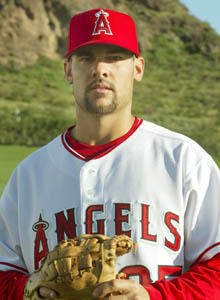
10/14/05
No. You haven’t seen this man. Not in over a week. Yet he may be the biggest reason the Angels are down 2-1 to the Chicago White Sox
He’s not Doug Eddings. He’s not Josh Paul. He’s Casey Kotchman.
Angel fans, readers of Baseball America, and those who have the distinct pleasure of watching a baseball game with me know who Kotchman is. If you don’t fall into one of those groups, the name may be new to you. Casey Kotchman may very well be the second best hitter on the Los Angeles Angels of Anaheim.
Now you may be saying, wait, if he’s the second best hitter on the team, why haven’t I seen him in the entire playoffs? That’s a good question, and one that someone should probably ask Mike Scioscia.
Look at Kotchman’s numbers this season, compared to those who are in the lineup instead. (VORP is a cumulative stat by the guys at Baseball Prospectus. It measures players factoring position, park effect, and a bunch of things I just don't have the equipment to do).
| PA | HR | RBI | AVG | OBP | SLG | VORP | |
| C. Kotchman | 143 | 7 | 22 | .278 | .352 | .484 | 9.2 |
| D. Erstad | 667 | 7 | 66 | .273 | .325 | .371 | 9.7 |
| J. Rivera | 376 | 15 | 59 | .271 | .316 | .454 | 10.2 |
| S. Finley | 440 | 12 | 54 | .222 | .271 | .374 | -2.5 |
Not only are Kotchman’s rate stats higher, but also his cumulative stats are almost as high as the regulars. Think that looks bad? Check out against Right-handed pitchers:
| PA | HR | RBI | AVG | OBP | SLG | |
| C. Kotchman | 111 | 7 | 20 | .286 | .355 | .551 |
| D. Erstad | 455 | 4 | 46 | .291 | .337 | .396 |
| J. Rivera | 226 | 11 | 38 | .284 | .326 | .498 |
| S. Finley | 314 | 9 | 33 | .201 | .252 | .347 |
Ok, so based on the numbers here, Juan Rivera seems to deserve a spot in the lineup. And Darin Erstad is the Angels unofficial captain, and as a guy who came up big for them in the 2002 postseason, I’ll give him the benefit of the doubt.
What about Steve Finley though? He was just as bad as an every day player could be this year. Only a stint on the disabled list cost him from having the lowest OPS of any regular in the American League. So why is he in the lineup? Is it because of his defense? Erstad was a Gold Glove CF as recently as 2002, and wasn’t moved because of any injury, so it’s hard to believe he’s forgotten how to play the position. Is it out of loyalty? Can’t be that, he was just signed as a free agent. So there’s really only one explanation. Finley signed a big free agent contract this past off season, and the Angels apparently feel the need to get at least some return on their investment. Instead what they may be getting is a ticket home while the White Sox march toward the World Series.
This was never more apparent than the 8th inning in tonight’s ALCS Game 3. John Garland had cruised through the first six innings, but showed some wear in the 7th, giving up a two run homer to Orlando Cabrera. After Kevin Gregg held the White Sox scoreless in the top of the 8th, the Angels needed to claw back some more. To lead off the inning Mike Scioscia finally went to his bench for a pinch hitter.
He went to Jeff DaVanon.
After DaVanon was retired on a broken bat grounder. Steve Finley came up. After a couple of fouls straight back, Lou Pinella noted that Garland was leaving his pitches up in the zone, almost hangars. Garland left three more fastballs up in the zone, the first two of which, Finley fouled off. The last one, he hit a line drive to medium depth right field, for the second out of the inning. The Angels didn’t score again.
Chances are, Kotchman wouldn’t have hit any of those balls out of the park either. In fact, if Kotchman comes to the plate, the White Sox probably bring Neil Cotts into the game. But wouldn’t you rather take your chances with a 22-year-old rising star with a .900 OPS against right-handers than a 40+ year whose star appears to have fallen to the tune of making outs a quarter of the times he comes to the plate?
Mike Scioscia didn’t think so, and it’s one of the reasons he is looking at a 2-1 deficit.
Subscribe to:
Posts (Atom)